
International Relations Review of Atlas Summer Courses

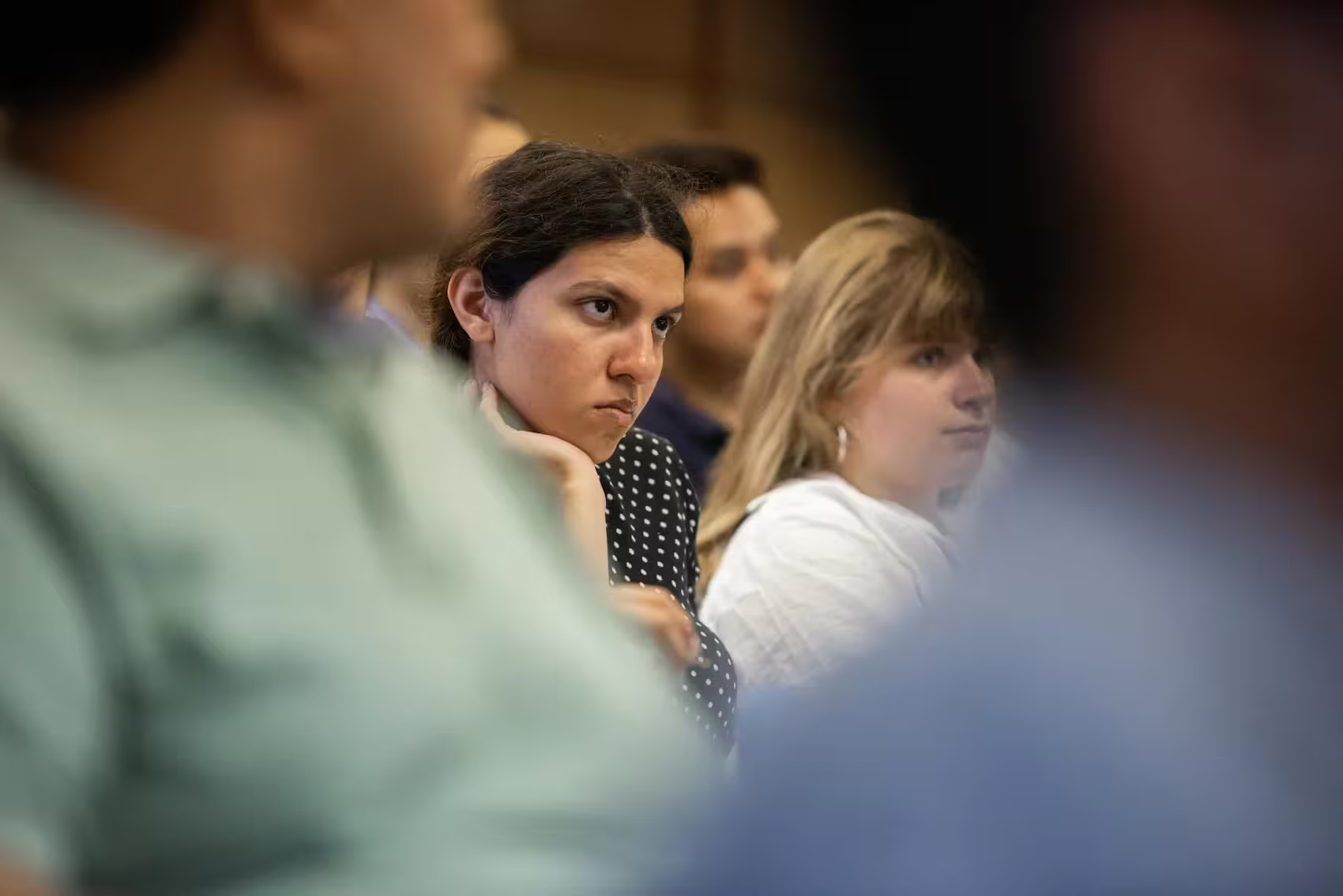
Studying International Relations in Oxford: Valeria’s Atlas Summer Courses Experience
Choosing an academic summer course can feel like a big step, particularly if you are travelling internationally, studying a subject in greater depth for the first time, or arriving without knowing anyone else on the programme.
That was exactly the situation for Valeria Fernández Álvarez when she travelled from Madrid to Oxford to study International Relations with Atlas Summer Courses.
In this student story, Valeria reflects on the academic side of her programme, the tutorial feedback she received, the friendships she made and how the experience helped her think more carefully about what she wanted to study at university.
Her experience is personal to her, and future programmes, tutors, accommodation and activities may differ. But her account gives prospective students an honest sense of what one Atlas International Relations programme was like.
Why Did Valeria Choose International Relations?
International Relations explores how countries, governments, institutions and other actors interact across borders.
The subject can include areas such as:
- international politics;
- diplomacy;
- conflict;
- international organisations;
- global governance;
- political theory;
- security;
- economics; and
- historical events that continue to influence international affairs.
For students considering subjects such as Politics, International Relations, Law, Economics or related social sciences, a summer programme can provide an opportunity to explore these ideas before making longer-term academic choices.
Valeria chose to spend two weeks studying International Relations with Atlas Summer Courses in Oxford.
She admits that before travelling, she was not entirely sure what to expect.
Travelling From Madrid to Oxford
Valeria travelled from Madrid to London before continuing to Oxford for her programme.
Her arrival was not completely straightforward.
Her luggage had been lost at the airport, she was travelling somewhere unfamiliar and she did not yet know any of the other students.
Understandably, she remembers feeling nervous on the first day.
That changed quickly once she reached her accommodation and met her roommate.
Valeria describes opening the door and being greeted by someone who immediately made her feel welcome.
For students worried about arriving alone, her experience is a useful reminder that many people joining an international summer course are in exactly the same position.
Almost everyone needs to make those first introductions.
What Was It Like Arriving Without Knowing Anyone?
This is one of the most common worries students have before a residential summer programme.
Who will I sit with?
What if everybody else already knows someone?
What if I don't get along with my roommate?
In reality, international programmes bring together many students arriving independently.
That shared experience can make introductions easier.
A simple conversation with a roommate or another student can quickly turn an unfamiliar environment into somewhere that feels much more comfortable.
For Valeria, meeting her roommate was the moment her nerves began to disappear.
What Did Valeria Study?
Valeria spent her academic programme exploring International Relations.
She describes studying theories, concepts and historical developments connected with the way international politics works.
A subject such as International Relations is particularly well suited to discussion because many questions do not have one universally accepted answer.
Students may examine questions such as:
Why do states cooperate?
Why do conflicts begin?
How effective are international organisations?
How much power should international institutions have?
What role do economics and trade play in international relations?
Why do countries respond differently to the same international crisis?
These kinds of questions encourage students to analyse arguments rather than simply memorise information.
What Was Valeria’s Tutor Like?
One of the strongest parts of Valeria's account is her description of her tutor.
She remembers him as knowledgeable, motivating and welcoming.
More importantly, she highlights the way he encouraged students to participate.
Rather than spending academic sessions simply listening, Valeria and her classmates were encouraged to contribute to discussions and become part of the conversation.
That mattered to her.
She describes the sessions as long compared with what she was used to at school, but says she remained engaged because of the way the material was taught.
Her experience reflects something important about academic teaching:
length matters less when students are actively involved.
Discussion-Based Learning
International Relations benefits from discussion because students can encounter different interpretations of the same event or problem.
A tutor might ask:
What motivates a state to act this way?
Would another theory explain the same event differently?
How would this policy affect another country?
Which evidence supports your argument?
What assumptions are you making?
These questions encourage students to defend their ideas rather than simply repeat information they have read.
For Valeria, being encouraged to participate made the academic experience more engaging.
What Were the Tutorials Like?
Valeria also remembers tutorials conducted in pairs.
These sessions gave students opportunities to receive detailed feedback on their academic work.
For Valeria, this was particularly memorable because she had not previously experienced somebody reviewing her work with that level of attention and then discussing it directly with her.
She valued not simply being told whether work was good or bad, but understanding how it could improve.
That difference matters.
Useful feedback should give students something they can act on.
Why Personalised Feedback Matters
Imagine receiving this feedback:
“This was good.”
Now compare it with:
“Your argument is interesting, but you need stronger evidence here and you haven't fully considered the opposing position.”
The second response tells you what to do next.
Detailed feedback can help students identify:
- strengths;
- weaknesses;
- gaps in reasoning;
- unclear arguments;
- missing evidence; and
- areas worth developing further.
Valeria says her tutorials made her want to improve rather than simply complete the work.
That is one of the most useful outcomes academic feedback can have.
Is an Atlas Tutorial an Oxford University Tutorial?
No.
This distinction should be completely clear.
Valeria attended an Atlas Summer Courses programme in Oxford.
Atlas Summer Courses is an independent summer education provider and is not affiliated with the University of Oxford.
Tutorial-style teaching describes the format of an Atlas academic session. It should not be presented as University of Oxford teaching.
Likewise, attending a programme in Oxford does not make a student a member of the University of Oxford.
Meeting Students From Around the World
Academics were only one part of Valeria's summer.
She also remembers the international student community particularly positively.
Her classmates came from different countries, cultures and backgrounds.
That mattered both socially and intellectually.
International Relations is a subject concerned with the relationships between countries and societies.
Studying it alongside students who have grown up in different parts of the world can introduce perspectives that may never appear in a textbook.
A political question may look very different depending on where you live.
An international institution may be viewed positively in one country and criticised in another.
Students can therefore learn from one another as well as from tutors.
Friendships During Summer School
Valeria says she formed friendships that continued after the programme finished.
At the time she wrote about her experience, she was still in contact with people she had met during those two weeks and had plans to meet some of them again in Rome.
That is her individual experience rather than a guarantee that every student will make lifelong friends.
But residential programmes create plenty of opportunities for friendships to develop.
Students spend time together:
in classes;
during meals;
through activities;
around the accommodation;
and during the wider programme.
Two weeks can feel short, but spending that much concentrated time together can make new friendships develop quickly.
The Importance of the Wider Student Community
Valeria also speaks positively about the wider atmosphere of the programme.
She remembers people being approachable and welcoming, including members of staff.
For a student travelling internationally without an existing friendship group, this can make a substantial difference.
A strong summer experience does not depend only on academic content.
Students also need to feel comfortable asking questions, participating in activities and speaking to staff when they need help.
The people surrounding the programme shape the experience as much as the timetable does.
Studying International Relations With an International Group
There is an interesting connection between Valeria's subject and the people around her.
International Relations examines countries, cultures, institutions and political perspectives.
An international student group brings some of those differences directly into the room.
A discussion about migration, foreign policy or international organisations may feel very different when classmates have personal experience of different political systems.
That does not mean every student is expected to represent their entire country.
It simply means a diverse group can bring a broader range of experiences into academic conversation.
How Did the Course Affect Valeria’s University Decisions?
When Valeria reflected on her programme, she was in the process of applying to universities in several countries, including institutions in:
the United States;
the Netherlands;
the United Kingdom;
and Spain.
She says the summer helped her think more carefully about where she wanted to apply and what she wanted to study.
That is a reasonable way to think about academic summer programmes.
They can give students more information before they make university choices.
Someone might confirm that they enjoy a subject.
Another student might realise that a different discipline suits them better.
Both outcomes can be useful.
Does Attending a Summer Course Improve a University Application?
Valeria personally felt that universities responded positively to seeing the programme within her applications.
That should be presented as her perception and experience, not as a universal admissions fact.
No independent summer programme can guarantee that attending it will improve a student's chance of admission.
Different universities evaluate applications differently.
Simply paying to attend a summer programme is not an academic achievement equivalent to examination results or formal qualifications.
What can be more meaningful is what the student actually does with the experience.
Did they develop an academic interest?
Read more afterwards?
Ask better questions?
Complete independent work?
Change their view of a subject?
Those reflections can be far more useful than simply listing attendance.
What Can a Summer Programme Demonstrate?
A summer programme may give a student experiences they can discuss later.
For example, they may be able to explain:
why they chose the subject;
which academic question interested them most;
how feedback changed their work;
what they learned from other students;
or why the programme affected their future academic choices.
Those are individual learning outcomes.
The student still needs to demonstrate their own academic ability through the application process required by the universities to which they apply.
Can International Relations Help You Choose a University Subject?
Potentially.
Many students considering International Relations are also interested in:
Politics;
Law;
History;
Economics;
Philosophy;
Public Policy;
or other social sciences.
A summer course can expose students to some of the questions each subject asks.
Perhaps you enjoy analysing relations between states but discover you are most interested in international law.
Maybe political theory becomes more interesting than diplomacy.
Or perhaps studying International Relations confirms that it is exactly what you want to pursue.
Academic exploration helps students make those distinctions.
What Skills Can International Relations Students Develop?
International Relations involves more than learning names, dates and institutions.
Students may need to practise:
critical thinking;
evaluating evidence;
constructing arguments;
understanding competing perspectives;
academic discussion;
research;
and communication.
A complicated international issue rarely has one neat explanation.
Students therefore need to become comfortable with ambiguity.
Two theories can explain the same event differently.
Two countries can interpret the same policy in opposite ways.
Learning to evaluate those competing perspectives is an important part of the subject.
Critical Thinking in International Relations
Consider a simple question:
Why do countries cooperate?
One student might say shared interests.
Another might point to international institutions.
Someone else could argue that cooperation works when powerful countries benefit from it.
All three could construct arguments.
The academic task is not simply deciding which answer sounds nicest.
Students need to examine the evidence and assumptions behind each position.
This is where discussion-based teaching can become particularly valuable.
Learning to Debate Ideas Respectfully
International Relations can involve controversial subjects.
War.
Human rights.
Migration.
Economic inequality.
Foreign intervention.
International institutions.
Students will not always agree.
That is normal.
The ability to disagree constructively is academically valuable.
Students can learn to challenge an argument rather than attack the person making it.
They can also discover that listening carefully to opposing views may improve their own position.
Preparing for University-Style Learning
Valeria describes her tutorials and academic feedback as giving her a different learning experience from what she had previously known.
Summer programmes can introduce some habits that become increasingly relevant as students move towards university.
These include:
independent preparation;
active seminar participation;
academic discussion;
responding to feedback;
and taking greater responsibility for one's own work.
A two-week programme is not equivalent to studying for a university degree.
But it can give students a short opportunity to practise these habits.
What Does “University-Style” Mean?
The term should be used carefully.
It can refer to teaching approaches such as:
seminars;
tutorial-style discussion;
independent preparation;
research;
and academic feedback.
It does not mean that students are enrolled at a university simply because an independent summer provider uses similar teaching formats.
For Atlas Summer Courses, “university-style” describes aspects of the teaching approach.
Atlas remains an independent provider.
Did Valeria Experience University Life?
Valeria says the programme gave her a taste of some aspects of what she imagined university life might feel like.
That is a personal reflection.
A short residential summer course is not the same as being a university student.
University involves longer-term academic work, formal assessment, independent living and responsibilities that cannot be recreated completely in two weeks.
However, spending time away from home, managing a new routine, studying independently and meeting new people can give teenagers an introduction to some of those experiences.
Living Away From Home
For many students aged 16–17, this can be one of the biggest changes.
You need to organise yourself.
Find your way around.
Remember your timetable.
Manage your belongings.
Meet unfamiliar people.
And ask for help when you need it.
Valeria's difficult arrival—with lost luggage and first-day nerves—could easily have made the beginning of the programme stressful.
Instead, meeting her roommate quickly gave her a sense that things would be all right.
Residential experiences often contain those small moments of independence.
What If Your Travel Doesn't Go to Plan?
Valeria's lost luggage is also a useful reminder that international travel does not always run perfectly.
Flights can be delayed.
Bags can disappear.
Plans change.
Students and families should prepare sensibly for international travel.
Important documents, medication and essential items should be managed carefully, and students should know how to contact the relevant people if they need help.
One disruption at the beginning of a trip does not necessarily determine the rest of the experience.
Valeria's own account certainly demonstrates that.
Why Study International Relations During the Summer?
A summer programme can appeal to students who are curious about current affairs and want to understand the deeper ideas behind them.
News often tells you what happened.
International Relations asks:
Why did it happen?
Which actors had power?
Which historical events influenced the situation?
Which theories help explain their behaviour?
What might happen next?
For students who enjoy these questions, International Relations can provide a structured way to explore them.
Who Might Enjoy an International Relations Summer Course?
The subject may particularly appeal to students interested in:
global politics;
diplomacy;
history;
international organisations;
conflict;
economics;
human rights;
security;
and current affairs.
You do not need to have decided on a career in diplomacy or politics.
The point of a summer programme can simply be to find out whether you enjoy thinking about these questions.
Do You Need to Have Studied International Relations Before?
Students should check the entry requirements for their particular Atlas Summer Course.
Many teenagers will not have studied International Relations as a standalone subject at school.
That makes summer study an opportunity to encounter some of its major concepts for the first time.
A genuine interest in international affairs can be a much more realistic starting point than expecting applicants to arrive with university-level knowledge.
How Can You Prepare for an International Relations Summer Course?
Start by following any pre-course preparation supplied by Atlas or your tutor.
You might also benefit from following reputable current-affairs coverage before arriving.
Ask yourself:
Which international issue interests me most?
Why do countries disagree about it?
Who has power?
Which organisations are involved?
What historical events shaped the current situation?
You do not need to arrive with perfect answers.
Arrive with questions.
The Value of Asking Questions
International Relations becomes much more interesting once students stop looking for one perfect answer.
A strong seminar question might be:
Are international organisations genuinely powerful, or only as powerful as states allow them to be?
That question invites disagreement.
Different students can defend different positions.
Evidence can be compared.
Assumptions can be challenged.
This is the kind of academic conversation Valeria says she particularly enjoyed.
International Relations and Different Perspectives
International issues are rarely interpreted identically everywhere.
A policy that appears sensible from one country's perspective may threaten another country's interests.
Historical relationships influence modern decisions.
Domestic politics affects foreign policy.
Economics changes incentives.
Culture shapes public opinion.
International Relations encourages students to look at these interacting factors rather than reducing global events to simple explanations.
Why Oxford?
Oxford provided the setting for Valeria's Atlas Summer Courses experience.
For an international student arriving from Madrid, living temporarily in Oxford also meant discovering a new city alongside the academic programme.
However, the programme should be evaluated according to what Atlas Summer Courses itself provides rather than simply because it takes place in Oxford.
The city is the location.
Atlas is the programme provider.
Is Atlas Summer Courses Part of Oxford University?
No.
Atlas Summer Courses is an independent summer education provider and is not affiliated with the University of Oxford.
Students attending an Atlas Summer Courses in Oxford are not admitted to the University of Oxford.
Likewise, the academic programme and certificates are provided through Atlas rather than the University.
This distinction should remain clear when prospective students compare summer programmes.
What About Valeria’s Reference to Somerville?
Valeria's original account refers to her course experience at Somerville.
Where an independent summer programme uses accommodation or teaching facilities associated with another educational institution, that does not make participants students of that institution.
Students remain enrolled with Atlas Summer Courses.
Use of a venue should therefore be kept separate from claims about programme provision, endorsement or academic affiliation.
Current students should also check their own programme information rather than assuming that accommodation or teaching venues used in a previous year will still be used.
Do Future Students Stay in the Same Place?
Not necessarily.
Valeria is describing the programme she personally attended.
Accommodation and teaching venues can change between years.
Future students should use the current Atlas course information for their own dates rather than treating an alumni story as a current accommodation guide.
The same applies to tutors, excursions and specific activities.
A testimonial is a record of one student's experience, not a permanent programme specification.
Student Testimonials and Individual Outcomes
Valeria describes her summer extremely positively.
She says the programme exceeded her expectations and that she felt fortunate to have attended.
That is her genuine personal view.
Prospective students should nevertheless understand that experiences vary.
A future student may have:
a different tutor;
different classmates;
different accommodation;
different activities;
and different personal goals.
Testimonials are useful because they show what a real student experienced.
They should not be treated as guarantees.
Would Valeria Recommend the Experience?
Yes.
Valeria says she would encourage someone considering giving the programme as a gift to go ahead, based on her own experience.
She particularly valued:
the academic teaching;
tutorial feedback;
international student community;
friendships;
staff;
and the opportunity to experience a different environment.
For her, giving up part of her summer for an academic programme did not feel like a sacrifice once she was there.
She felt the experience was worth it.
Should You Gift a Summer Course?
That depends on the student.
A summer programme can be a meaningful gift for somebody who genuinely wants the experience.
But because the student will be the person travelling, studying and living away from home, they should ideally have a say in the subject and programme.
The best approach is often to gift the opportunity, then choose the details together.
A student who is genuinely interested in International Relations is likely to get more from the programme than somebody attending because an adult decided it would look impressive.
What Parents Can Learn From Valeria’s Story
Parents may understandably focus first on academics.
Valeria's story shows that several other things can shape the experience too.
The roommate matters.
The staff matter.
The other students matter.
Feedback matters.
Feeling comfortable asking questions matters.
And even something going wrong during travel does not necessarily ruin the experience.
When comparing summer programmes, families should therefore look at the complete student experience rather than simply subject titles and locations.
What Students Can Learn From Valeria’s Story
Perhaps the most useful lesson is:
go into the experience willing to participate.
Valeria engaged with her tutor.
She valued feedback.
She spoke with people from other backgrounds.
She developed friendships.
And she used the experience to think about future university choices.
Students cannot control every part of a summer programme.
They can control how much they engage with it.
Can Two Weeks Really Make a Difference?
Two weeks is short.
It will not turn somebody into an expert in International Relations.
It will not replicate a degree.
And it cannot determine an entire career.
But it can still be enough time to:
encounter a subject seriously;
meet people;
receive academic feedback;
experience living somewhere different;
and learn something about what you enjoy.
The value lies in exploration rather than mastery.
Valeria’s International Relations Experience in Her Own Words
Valeria's overall reaction to the academic programme was enthusiastic.
She describes the course as exceeding her expectations and particularly praises her tutor's ability to make sessions engaging and encourage students to participate.
She also highlights the friendships she formed and the supportiveness of the staff.
Her experience can therefore be summarised through three things:
academic engagement
personal feedback
and
international friendships
Those were the parts that mattered most to her.
Frequently Asked Questions About Valeria’s Atlas Experience
What did Valeria study?
Valeria studied International Relations with Atlas Summer Courses in Oxford.
Where did she travel from?
She travelled from Madrid to London before continuing to Oxford.
Did she know anyone before arriving?
No. She describes arriving nervous and not knowing any other students.
What helped her settle in?
Valeria says meeting her welcoming roommate immediately helped her feel more comfortable.
What did she think of her tutor?
She describes him as highly knowledgeable, motivating, interesting and welcoming.
Were students expected to participate?
According to Valeria's account, yes. Her tutor encouraged students to contribute actively to discussions.
Did she have tutorials?
Yes. Valeria describes tutorials conducted in pairs, during which she received detailed feedback on her work.
Did she make friends?
Yes. She says she remained in contact with friends she met during the programme and later planned to meet some of them again.
Did the programme help her think about university?
Valeria says it helped her clarify where she wanted to apply and what she might want to study.
Does Atlas guarantee that universities value its courses?
No. Valeria personally believed her summer course was viewed positively in her applications, but universities make their own admissions decisions and outcomes vary.
Does attending Atlas guarantee university admission?
No.
Is Atlas Summer Courses part of the University of Oxford?
No. Atlas Summer Courses is an independent provider.
Was Valeria an Oxford University student?
No. She was an Atlas Summer Courses participant studying in Oxford.
What Should You Look for in an International Relations Summer Course?
If Valeria's story has made you interested in studying International Relations, look closely at the current programme before applying.
Consider:
the topics covered;
class size;
teaching format;
tutor contact;
tutorials and feedback;
independent work;
accommodation;
activities;
supervision;
and the international composition of the student group.
The location may be exciting, but the academic structure is what determines what you actually spend your lessons doing.
What Should You Ask Yourself Before Applying?
Ask yourself:
Do I enjoy discussing current affairs?
Am I interested in why countries behave the way they do?
Do I like hearing different perspectives?
Would I enjoy debating complicated questions without obvious answers?
Am I willing to contribute to discussion?
Would I like to meet students from other countries?
If several of those answers are yes, International Relations may be a subject worth exploring.
Final Thoughts: Valeria’s International Relations Summer Course
Valeria Fernández Álvarez arrived in Oxford from Madrid unsure exactly what her summer programme would be like.
Her luggage had been lost.
She knew nobody.
And she was understandably nervous.
Then she met her roommate.
She began her International Relations course.
She found herself enjoying long academic discussions.
She received detailed feedback during tutorials.
And she developed friendships with students from different backgrounds that continued after the summer ended.
For Valeria, the programme also became part of the process of thinking about university.
She later described it as helping her clarify where she wanted to apply and what she wanted to study.
That does not mean every Atlas student will follow the same path.
Nor does attending an independent summer programme guarantee any particular university outcome.
What Valeria's story does show is how much can happen when a student arrives somewhere new and decides to engage fully with the experience.
A summer programme can give you time to explore a subject.
It can introduce you to people you would never otherwise meet.
And it can help you discover what you want to investigate next.
For Valeria, that subject was International Relations.
For the next student, it may lead somewhere entirely different.
Interested in International Relations?
If you are interested in global politics, diplomacy, international organisations and the forces that shape relations between countries, explore the current International Relations programmes available through Atlas Summer Courses.
Check the current age requirements, course content, teaching structure, dates and programme arrangements before applying.
Atlas Summer Courses is an independent summer education provider and is not affiliated with the University of Oxford.
Apply now to begin your application.
About the author
Rhys Mackenzie is responsible for creating and maintaining educational content at Atlas Summer Courses, helping students and families access clear, accurate information about studying in Oxford. With several years of experience in digital content and student-focused resources, Rhys specialises in presenting academic programmes in a way that reflects the quality and integrity of Atlas Summer Courses' academic offering. Learn more about Rhys here.
Summary
Valeria Fernández Álvarez recounts her enriching experience studying International Relations at Atlas Summer Courses. The exceptional teaching, diverse classmates, and valuable insights made it an unforgettable academic journey. Find out more and apply to explore International Relations.