
10 Famous Nobel Prize Winners Connected to Oxford

Key takeaways:
- Oxford has connections with numerous Nobel Prize winners who studied, taught or conducted research at the University of Oxford.
- Their achievements span Physics, Chemistry, Medicine and Peace.
- Dorothy Hodgkin won the 1964 Nobel Prize in Chemistry for her work using X-ray techniques to determine biochemical structures.
- Howard Florey and Ernst Chain shared the 1945 Nobel Prize for work connected with the discovery and therapeutic development of penicillin.
- Roger Penrose received the 2020 Nobel Prize in Physics for his work demonstrating that black hole formation is predicted by general relativity.
- John B. Goodenough’s research contributed to the development of modern lithium-ion batteries.
- Other Oxford-connected laureates include Erwin Schrödinger, Peter Medawar, Cyril Hinshelwood, Aung San Suu Kyi and Lester B. Pearson.
- Oxford’s Nobel connections demonstrate the breadth of scientific, academic and political work associated with the University.
- Their stories highlight the importance of curiosity, collaboration, evidence and persistence in academic enquiry.
- Students spending time in Oxford can explore the city’s academic history, while independent summer programmes remain separate from the University of Oxford.
10 Famous Nobel Prize Winners Connected to Oxford
Oxford has long been associated with scientific discovery, academic research and influential ideas. Among the people who have studied, taught or carried out research at the University of Oxford are numerous Nobel Prize winners, with achievements spanning Physics, Chemistry, Medicine, Literature, Economics and Peace. (Oxford University)
From the development of penicillin to discoveries about black holes and lithium-ion batteries, their work has influenced medicine, science, technology and society around the world.
Here are ten famous Nobel laureates with significant connections to the University of Oxford — and the work for which they received one of the world's best-known academic honours.
1. Dorothy Hodgkin — Nobel Prize in Chemistry, 1964
Dorothy Hodgkin was one of the twentieth century's most influential chemists and remains the only British woman to have received a Nobel Prize in science.
Hodgkin studied Chemistry at Somerville College before completing doctoral research at Cambridge and returning to Oxford as a research fellow. She became a pioneer of X-ray crystallography, using the technique to determine the structures of important biochemical substances.
Her work included determining the structures of penicillin and vitamin B12, and in 1964 she received the Nobel Prize in Chemistry for her X-ray investigations into the structures of important biochemical substances.
2. Howard Florey — Nobel Prize in Physiology or Medicine, 1945
Howard Florey played a central role in transforming penicillin from an important scientific discovery into an effective medical treatment.
Florey originally came to Oxford as a Rhodes Scholar and later became Professor of Pathology and Head of the Sir William Dunn School of Pathology.
Working with Ernst Chain, Norman Heatley and other researchers, Florey led work that enabled penicillin to be purified, produced and demonstrated as an effective treatment against bacterial infection.
In 1945, Florey and Chain shared the Nobel Prize in Physiology or Medicine with Alexander Fleming for the discovery of penicillin and its curative effect in infectious diseases.
3. Ernst Chain — Nobel Prize in Physiology or Medicine, 1945
Ernst Chain was another key member of the Oxford team responsible for developing penicillin into a practical medical treatment.
Chain worked at Oxford's Sir William Dunn School of Pathology, where he collaborated with Howard Florey and other researchers investigating antibacterial substances.
Their work helped establish the therapeutic potential of penicillin and paved the way for its wider use as an antibiotic. Chain, Florey and Fleming shared the 1945 Nobel Prize in Physiology or Medicine.
Their story is also a reminder that major scientific breakthroughs are often collaborative rather than the achievement of a single individual.
4. Erwin Schrödinger — Nobel Prize in Physics, 1933
The name Erwin Schrödinger is familiar to many students because of the famous thought experiment involving Schrödinger's cat.
His contribution to science, however, went much further.
Schrödinger was one of the central figures in the development of quantum mechanics, creating the wave equation that bears his name and helping transform physicists' understanding of matter at atomic and subatomic scales.
He shared the 1933 Nobel Prize in Physics with Paul Dirac and subsequently served as a Fellow of Magdalen College, Oxford, from 1933 to 1936. (Oxford University)
5. Roger Penrose — Nobel Prize in Physics, 2020
Mathematician and physicist Sir Roger Penrose received half of the 2020 Nobel Prize in Physics for demonstrating that black hole formation is a robust prediction of Einstein's general theory of relativity.
Penrose has a long academic association with the University of Oxford and is Emeritus Rouse Ball Professor of Mathematics and Emeritus Fellow of Wadham College.
His work is a fascinating example of the relationship between Mathematics and Physics, demonstrating how mathematical reasoning can help us understand some of the most extreme objects in the universe.
6. John B. Goodenough — Nobel Prize in Chemistry, 2019
Anyone who has used a smartphone, laptop or electric vehicle has encountered technology influenced by the work of John B. Goodenough.
Goodenough served as Head of Inorganic Chemistry at Oxford from 1976 to 1986. During this period, his research contributed to the development of cathode materials that became crucial to rechargeable lithium-ion batteries.
In 2019, Goodenough shared the Nobel Prize in Chemistry with M. Stanley Whittingham and Akira Yoshino for the development of lithium-ion batteries.
Their work helped enable the rechargeable technology now used across portable electronics and electric vehicles.
7. Aung San Suu Kyi — Nobel Peace Prize, 1991
Aung San Suu Kyi studied Philosophy, Politics and Economics at St Hugh's College, Oxford, before becoming one of Myanmar's most internationally recognised political figures. Oxford lists her among its Nobel Peace Prize laureates.
She received the Nobel Peace Prize in 1991 for her non-violent struggle for democracy and human rights.
Her subsequent political career has also attracted significant international criticism, particularly in relation to the treatment of the Rohingya population in Myanmar.
Her story demonstrates that the reputations and legacies of major political figures can be complex and can change significantly over time.
8. Lester B. Pearson — Nobel Peace Prize, 1957
Before becoming Prime Minister of Canada, Lester B. Pearson studied at Oxford and was associated with St John's College.
Pearson received the 1957 Nobel Peace Prize for his contribution to resolving the Suez Crisis and the development of international peacekeeping.
He later served as Prime Minister of Canada from 1963 to 1968.
Oxford lists Pearson among the Nobel Peace Prize winners connected with the University.
9. Sir Peter Medawar — Nobel Prize in Physiology or Medicine, 1960
Sir Peter Medawar was a scientist whose research transformed understanding of the immune system and helped establish important scientific foundations for organ transplantation.
Medawar's Oxford connections included a fellowship at Magdalen College and a senior research fellowship at St John's College.
His research explored immunological tolerance — helping scientists understand why the immune system accepts some cells and tissues while attacking others.
In 1960, Medawar shared the Nobel Prize in Physiology or Medicine with Frank Macfarlane Burnet for discoveries concerning acquired immunological tolerance.
10. Sir Cyril Hinshelwood — Nobel Prize in Chemistry, 1956
Sir Cyril Hinshelwood spent much of his academic career at Oxford, where he studied and later became a leading chemist.
He was a tutor at Trinity College before serving as Dr Lee's Professor of Chemistry from 1937 to 1964.
Hinshelwood investigated chemical reaction kinetics — how chemical reactions occur and the factors that determine their rates.
He shared the 1956 Nobel Prize in Chemistry with Nikolay Semenov for research into the mechanisms of chemical reactions.
What Is the Nobel Prize?
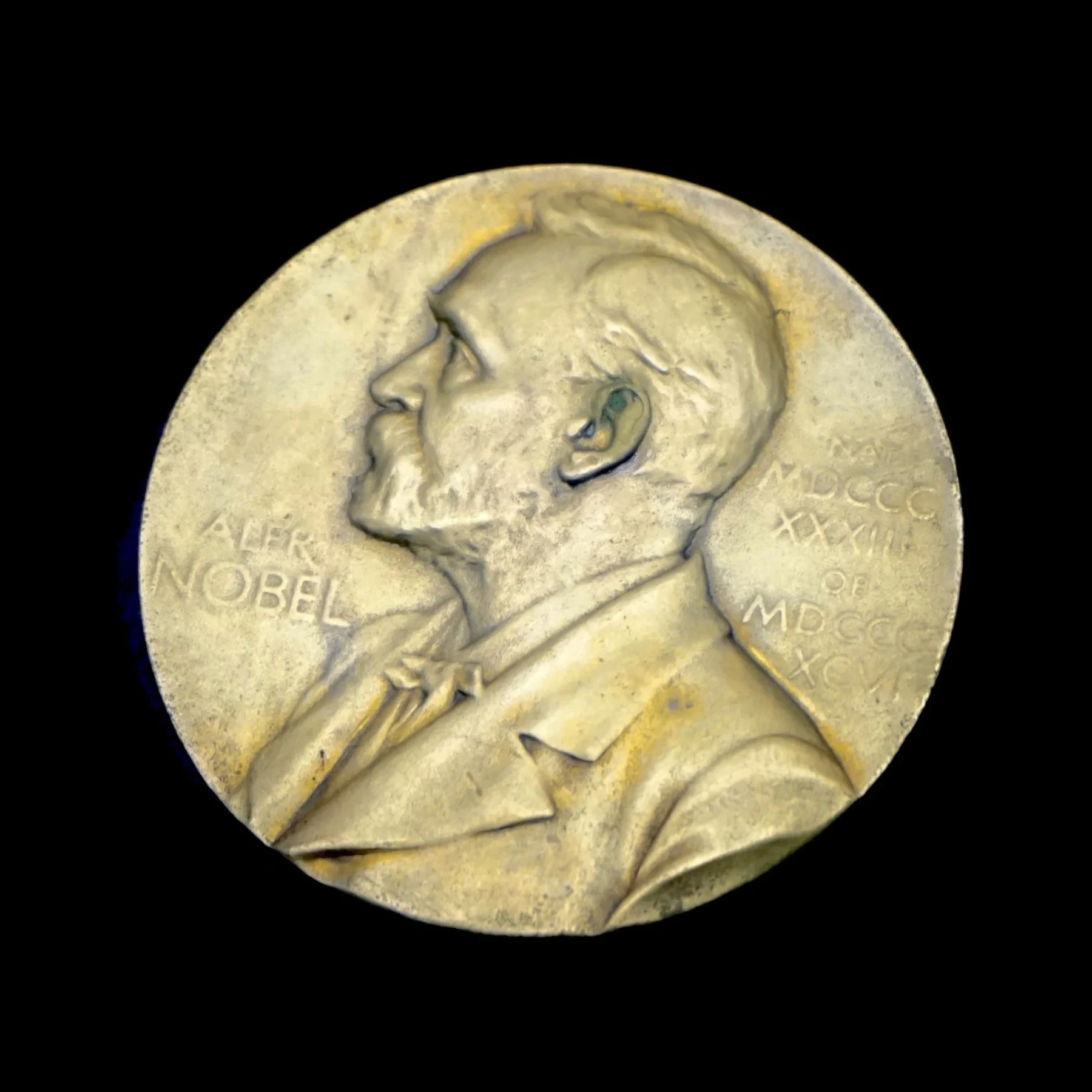
The Nobel Prizes originated from the will of Swedish inventor and industrialist Alfred Nobel, who directed that much of his fortune should fund prizes recognising achievements that had benefited humankind.
Nobel Prizes are awarded in Physics, Chemistry, Physiology or Medicine, Literature and Peace. The Sveriges Riksbank Prize in Economic Sciences in Memory of Alfred Nobel was established later.
The University of Oxford has connections with Nobel laureates across all six prize categories, including former students, researchers and academic staff.
Why Is Oxford Connected to So Many Nobel Prize Winners?
There is no single explanation.
For centuries, the University of Oxford has brought together students, academics and researchers working across a wide range of disciplines. Some Nobel laureates studied there, while others conducted research, taught or held academic positions at the University.
The nature of those connections differs considerably from person to person.
The development of penicillin provides one particularly significant example. At Oxford's Sir William Dunn School of Pathology, Howard Florey, Ernst Chain, Norman Heatley and their colleagues carried out work that helped transform penicillin into an effective medical treatment.
Nobel Prize-Winning Research Connected to Oxford
Several Nobel Prize-winning achievements have particularly strong connections with research conducted at the University of Oxford.
The Oxford penicillin team's work helped establish penicillin as an effective antibiotic. Dorothy Hodgkin conducted important crystallographic research in Oxford, while John Goodenough's work there contributed to the development of materials essential to modern lithium-ion batteries. Roger Penrose's long association with Oxford includes his Nobel Prize-winning work on black hole formation.
These discoveries span very different disciplines, but each demonstrates how sustained investigation of difficult questions can eventually have consequences far beyond the original research.
What Can Students Learn From Nobel Prize Winners?
It can be tempting to view Nobel laureates as exceptional individuals whose achievements have little connection with ordinary academic life.
But their careers highlight some much more accessible lessons.
Important discoveries often begin with questions. Researchers encounter something they do not understand, challenge an existing explanation or develop a different way of approaching a problem.
Research also involves uncertainty.
Experiments fail. Hypotheses are challenged. Conclusions change when new evidence emerges.
Winning a Nobel Prize is hardly a sensible measure of a student's success. But the underlying academic habits are worth developing: asking good questions, following evidence, responding to criticism and being willing to reconsider what you thought you knew.
Exploring Oxford's Academic History
For students spending time in Oxford, the city's academic history can make many of these discoveries feel more tangible.
Oxford contains colleges, museums, libraries and scientific buildings associated with generations of researchers, writers and thinkers. The University also remains an active centre of teaching and research today.
Students visiting or attending independent programmes in the city can experience Oxford's historic surroundings and learn more about the people and discoveries associated with them.
Importantly, spending a summer in Oxford is not the same as studying at the University of Oxford. Independent summer course providers operate separately from the University, even where they hire university or college facilities.
Exploring Oxford With Atlas Summer Courses
Atlas Summer Courses offers independent academic summer programmes in Oxford, giving students the opportunity to explore their chosen subjects through small-group, discussion-based teaching.
Students are encouraged to ask questions, examine unfamiliar ideas, challenge assumptions and develop their own conclusions.
Oxford provides the setting for these programmes, but Atlas Summer Courses operates independently from the University of Oxford.
Atlas Summer Courses is an independent organisation. Its Oxford programmes are not part of, affiliated with, authorised, approved or endorsed by the University of Oxford or any of its colleges.
From Penicillin to Black Holes
The Nobel laureates on this list worked on remarkably different questions.
Some investigated molecules and chemical reactions. Others explored the immune system, international politics or objects at the extremes of our understanding of the universe.
Their Oxford connections also differ: some studied at the University, some taught there and others conducted significant research there.
Together, their stories offer an insight into the breadth of academic work associated with Oxford — and into the curiosity, collaboration and persistence behind major discoveries.
For students, perhaps that is the most useful lesson:
you rarely know where a good question might eventually lead.
About the author
Rhys Mackenzie is responsible for creating and maintaining educational content at Atlas Summer Courses, helping students and families access clear, accurate information about studying in Oxford. With several years of experience in digital content and student-focused resources, Rhys specialises in presenting academic programmes in a way that reflects the quality and integrity of Atlas Summer Courses' academic offering. Learn more about Rhys here.
Summary
From the development of penicillin and lithium-ion batteries to discoveries about black holes, Nobel Prize winners connected to Oxford have contributed to some of the most influential ideas and breakthroughs of the modern era. Discover ten famous laureates who studied, taught or conducted research at the University of Oxford and the achievements for which they became known.