
The Museums of Kensington

Key takeaways:
- South Kensington is home to three of London’s best-known museums: the Natural History Museum, Science Museum and Victoria and Albert Museum (V&A).
- The museums are located close together around Exhibition Road, making it easy to explore several very different subjects in one area.
- The Natural History Museum explores the natural world, with collections covering animals, plants, fossils, rocks, minerals, meteorites and more.
- The Natural History Museum building opened in 1881 and is itself notable for its architecture and detailed representations of plants and animals.
- The Science Museum explores scientific discovery, engineering and technology, including subjects such as mathematics, medicine, flight and engineering.
- The V&A focuses on art, design and performance, with collections spanning fashion, photography, furniture, ceramics, sculpture, architecture, jewellery and textiles.
- The three museums demonstrate how academic subjects overlap, from the relationship between engineering and design to the influence of technology on science and society.
- Museums offer a different form of learning from textbooks and classrooms, allowing students to encounter objects, inventions and evidence directly.
- Students can use museums to explore beyond their existing academic interests and potentially discover entirely new subjects.
- General admission to all three museums is free, although some exhibitions, events and experiences may require paid tickets.
- Opening arrangements and exhibitions can change, so visitors should check current information before travelling.
- South Kensington also provides access to other cultural attractions and green spaces, making it a useful starting point for exploring London.
- The museums encourage academic curiosity across disciplines, whether a student is interested in science, medicine, engineering, history, art or the humanities.
- Tie-in to Atlas Summer Courses: London’s museums demonstrate how learning can continue beyond formal academic sessions and encourage students to follow their curiosity.
- Visits to these museums should not be described as automatically included in Atlas programmes. Activities and excursions vary according to age group, location, programme dates and itinerary.
- Main takeaway: the museums of Kensington give students the opportunity to explore different disciplines, make connections between subjects and discover new areas of interest outside the classroom.
The Museums of Kensington
Kensington is one of London's best areas for anyone interested in museums, culture and learning. In South Kensington, three major museums sit within a short distance of one another: the Natural History Museum, Science Museum and Victoria and Albert Museum (V&A).
Together, they cover an enormous range of subjects. In a single day, you could move from dinosaurs and the natural world to engineering and mathematics, before finishing with fashion, design and decorative arts.
For students spending time in London, the museums of Kensington also demonstrate something important about learning: interesting subjects rarely exist in isolation. Science overlaps with engineering, technology influences design, and objects from the past can tell us about everything from economics to social change.
Here are three of the museums that make South Kensington such an interesting place to explore.
Why Are There So Many Museums in South Kensington?
South Kensington's concentration of museums is closely connected with the development of the area as a centre for culture, science and education during the nineteenth century.
Today, the area around Exhibition Road is home to several major cultural institutions, with the Natural History Museum, Science Museum and V&A forming the best-known group.
Their proximity makes South Kensington particularly convenient for visitors. Rather than travelling across London between attractions, students can experience very different subjects within the same part of the city.
1. The Natural History Museum
Natural History Museum is perhaps the most immediately recognisable of South Kensington's museums.
The current museum building opened in 1881 and was designed by architect Alfred Waterhouse. Its architecture incorporates animals and plants throughout its decorative details, reflecting the idea of creating what has often been described as a "cathedral to nature". (Natural History Museum)
The museum cares for more than 80 million objects covering areas including animals, plants, fossils, rocks, minerals and meteorites. These collections are not simply displays for visitors: they also support scientific research into the natural world, Earth's history and the evolution of our solar system. (Natural History Museum)
What Can You Explore?
The Natural History Museum covers an extraordinary range of scientific subjects.
Depending on current galleries and displays, visitors can explore areas including:
- dinosaurs and prehistoric life;
- human evolution;
- mammals and other animals;
- oceans;
- rocks, minerals and meteorites;
- volcanoes and earthquakes; and
- biodiversity and the natural environment.
One of the building's most striking spaces is Hintze Hall, where a 25.2-metre blue whale skeleton has been suspended since the hall's redevelopment in 2017.
Even the building itself rewards attention. Waterhouse incorporated representations of living and extinct animals into its architecture, while the ceilings feature elaborate botanical designs.
For students interested in biology, environmental science, medicine or related subjects, the museum provides a chance to encounter scientific ideas outside a classroom.
Natural History Museum visitor information
2. The Science Museum
A short walk away is the Science Museum.
The Science Museum explores how scientific discoveries, engineering and technology have shaped the world around us.
Its galleries cover a wide range of subjects, making it particularly relevant to students interested in areas such as engineering, physics, mathematics, medicine and computing.
What Can You See at the Science Museum?
Current permanent galleries include areas devoted to engineering, mathematics, medicine, flight and the history of scientific development in London. The museum also offers interactive galleries alongside changing exhibitions. (Science Museum)
The Engineers gallery, for example, explores how engineering innovations affect people's lives, while the Mathematics gallery examines the role mathematics plays across society. The museum's extensive medicine galleries use objects and personal stories to explore the relationship between medicine, health and human experience.
That variety helps demonstrate just how broad science and engineering actually are.
An interest in mechanical engineering might lead towards transport or flight. Mathematics can connect with computing, economics or physics. Medicine combines scientific understanding with technology and questions about society.
Museums can make those connections much more visible than individual school subjects sometimes do.
3. The Victoria and Albert Museum
Across Exhibition Road is the Victoria and Albert Museum, commonly known as the V&A.
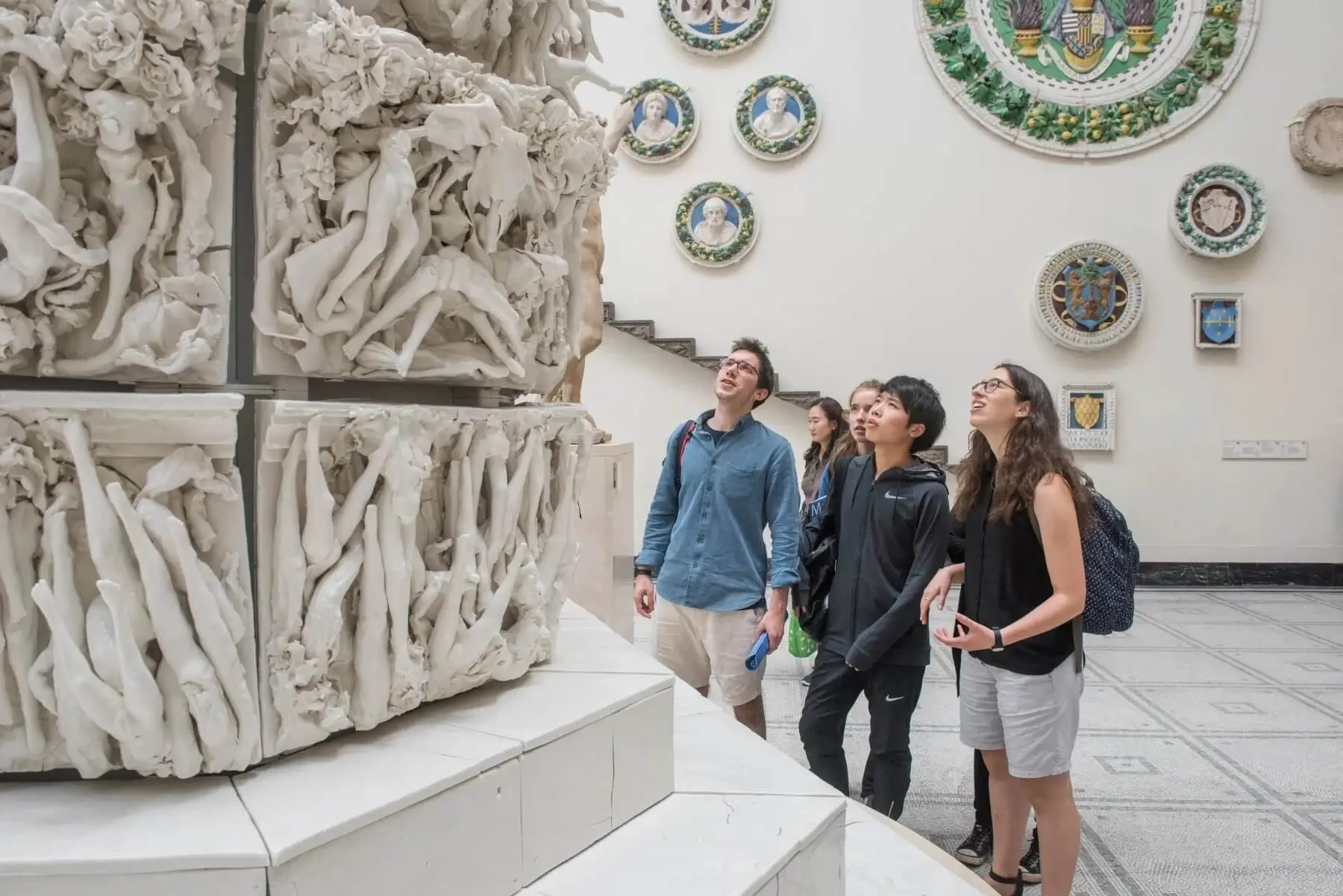
Where the Natural History Museum focuses on the natural world and the Science Museum explores science and technology, the V&A is centred on art, design and performance.
Its collections provide a very different way of examining human history.
What Can You Explore at the V&A?
The V&A's collections span an enormous range of objects and creative disciplines.
Students can encounter subjects connected with fashion, photography, furniture, ceramics, sculpture, architecture, jewellery, textiles and performance, among many others. Its online catalogue alone allows users to search more than 1.3 million objects.
That makes the museum particularly interesting for students of art, design, history and the humanities.
But its relevance extends further.
A piece of clothing can reveal information about manufacturing, social class and changing attitudes. Furniture can demonstrate developments in materials and production. An object created centuries ago can tell us about trade, politics, technology and the movement of ideas between cultures.
Looking carefully at objects can therefore become another form of research.
Three Museums, Very Different Subjects
One of the best things about South Kensington is how easy it is to move between disciplines.
Imagine beginning the morning looking at fossils in the Natural History Museum.
A few hours later, you could be considering the history of flight or mathematical ideas at the Science Museum.
Then you could cross Exhibition Road and explore fashion, sculpture or design at the V&A.
Those experiences might appear completely unrelated, but connections quickly emerge.
The development of new materials affects both engineering and fashion.
Scientific discoveries influence art and society.
Advances in manufacturing change what designers can create.
Understanding the natural world can lead to new technologies, while technology changes how we investigate nature.
For curious students, that ability to move between subjects is part of what makes museums valuable.
Why Are Museums Useful for Students?
Museums provide a different kind of learning from textbooks and classrooms.
Reading about a fossil is not quite the same as standing in front of one.
Studying engineering theoretically is different from seeing machines and technological developments placed within their historical context.
And learning about a period of history can feel more immediate when you can examine objects made and used by people who lived during it.
Museums can also encourage students to follow their own curiosity.
You might enter intending to spend an hour looking at one subject and discover something completely unexpected in the next gallery.
That freedom to investigate is valuable because academic interests do not always develop according to a planned curriculum.
Sometimes one interesting object or unanswered question is enough to send you towards an entirely new subject.
Are the Kensington Museums Free?
General admission to the Natural History Museum, Science Museum and V&A is free, although particular exhibitions, experiences or events may require a paid ticket. The V&A, for example, currently confirms free general admission while charging separately for some exhibitions and events. (Victoria and Albert Museum)
Opening arrangements, exhibitions and ticketing can change, so visitors should check each museum's official website before travelling.
This is particularly important for temporary exhibitions: an exhibition mentioned in an older article may no longer be running by the time you visit.
What Else Is Near the Kensington Museums?
The museums are only part of what makes this area interesting.
South Kensington and the surrounding area contain some of London's best-known cultural and educational landmarks, while nearby green spaces provide somewhere to take a break after several hours inside galleries.
The location also makes it relatively easy to combine a museum visit with exploring other parts of central London.
For students visiting the city for the first time, South Kensington can therefore be a useful introduction to London's ability to combine history, science, culture and modern city life within a relatively compact area.
Museums and Academic Curiosity
You do not have to visit a museum only because it relates directly to the subject you already study.
In fact, doing the opposite can sometimes be more interesting.
A future engineer might discover an unexpected interest in design at the V&A.
Someone interested in Medicine could explore the Natural History Museum before examining the history of healthcare at the Science Museum.
A humanities student might find themselves thinking about the social consequences of a scientific invention.
Academic curiosity often develops by making connections between subjects rather than keeping them completely separate.
That is one reason museums can be particularly valuable for students.
Exploring London With Atlas Summer Courses
At Atlas Summer Courses, we encourage students to remain curious beyond their formal academic sessions.
London's museums provide a good example of how learning can continue outside the classroom. A visit can introduce an unfamiliar subject, add context to something a student has already studied or simply raise a question they want to investigate afterwards.
However, we should not suggest that visits to the Natural History Museum, Science Museum or V&A are automatically included in every Atlas programme or itinerary unless they are specifically confirmed for that course.
Activities and excursions vary according to age group, location, programme dates and current itinerary.
Students and families should therefore check their current programme information for confirmed excursions and activities.
Discovering the Museums of Kensington
The museums of South Kensington demonstrate just how broad learning can be.
At the Natural History Museum, students can investigate life and the planet itself.
At the Science Museum, they can explore the discoveries and technologies humans have developed to understand and change the world.
At the V&A, they can see how people have turned ideas, materials and skills into art and design.
You could spend an entire day exploring them and still see only a fraction of what they contain.
And that may be the most useful thing about visiting a museum.
You do not need to leave knowing everything. You only need to leave curious enough to want to know more.
About the author
Rhys Mackenzie is responsible for creating and maintaining educational content at Atlas Summer Courses, helping students and families access clear, accurate information about studying in Oxford. With several years of experience in digital content and student-focused resources, Rhys specialises in presenting academic programmes in a way that reflects the quality and integrity of Atlas Summer Courses' academic offering. Learn more about Rhys here.
Summary
The museums of South Kensington offer students the opportunity to explore an extraordinary range of subjects within one part of London. From natural history and scientific discovery at the Natural History Museum to engineering and technology at the Science Museum and art and design at the V&A, the area demonstrates how different academic disciplines connect with one another. Museums can also encourage students to follow their curiosity beyond the classroom and discover subjects they may not previously have considered. For Atlas Summer Courses students, London’s museums provide a good example of the wider learning opportunities available in the city, although specific visits and excursions depend on each programme’s current itinerary.