
The City of Bath Day Trip

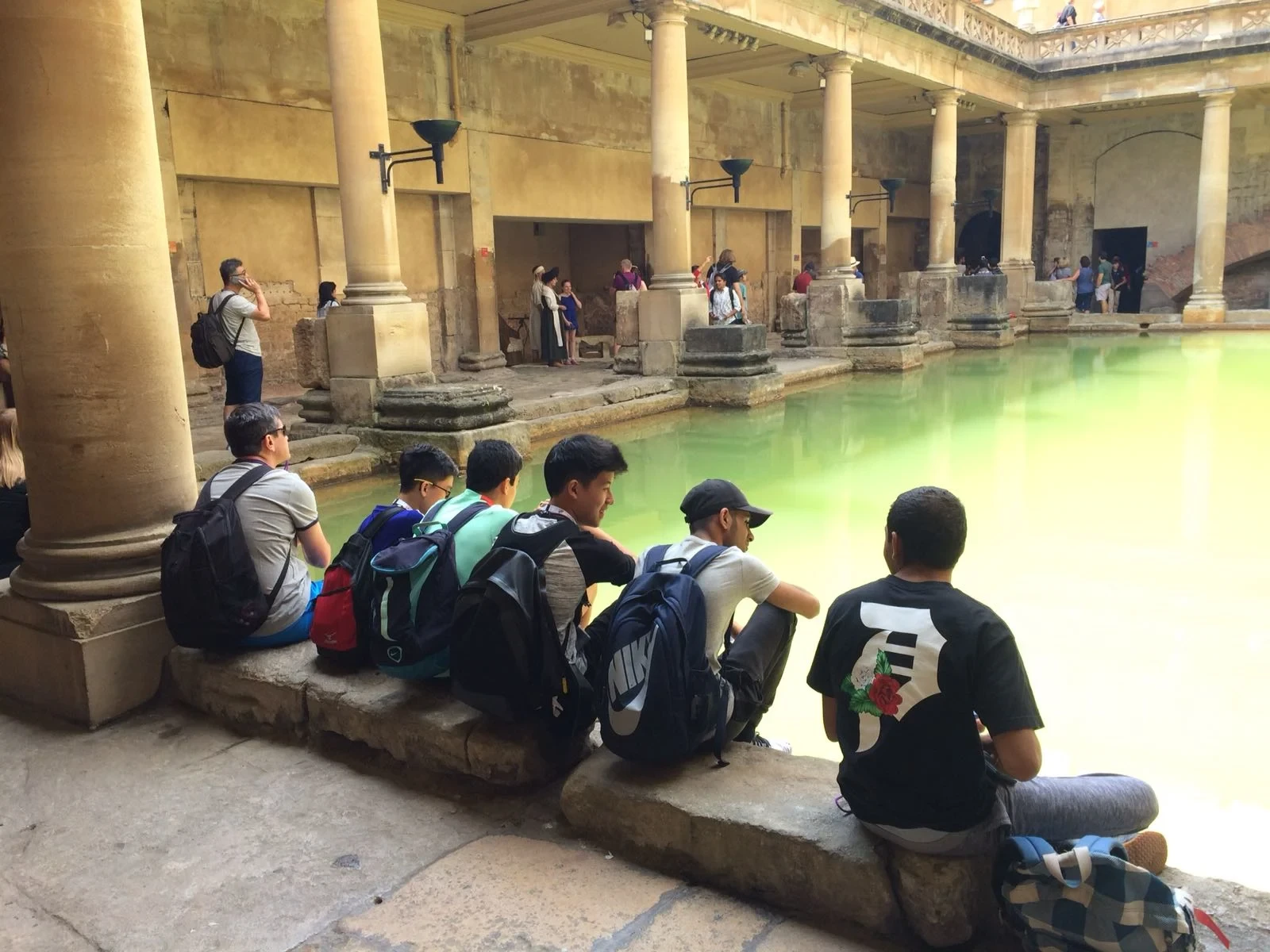
Key takeaways:
- Bath is a UNESCO World Heritage city with almost 2,000 years of history.
- The Roman Baths offer an insight into Roman engineering, religion, society and everyday life.
- Bath Abbey adds another layer to the city’s long architectural and religious history.
- Bath is famous for its Georgian architecture, including the Royal Crescent and The Circus.
- Pulteney Bridge and the River Avon contribute to Bath’s distinctive character and cityscape.
- Bath has strong literary connections with Jane Austen, particularly through Northanger Abbey and Persuasion.
- Exploring Bath on foot allows students to see Roman, medieval, Georgian and modern history existing side by side.
- The city can spark connections with subjects including History, Literature, Architecture, Engineering and Art.
- Day trips also give students opportunities to explore somewhere new and spend time with their international peers outside the classroom.
- Where included in an Atlas programme, a Bath day trip forms part of the wider summer experience, with specific excursions varying by programme, age group, dates and itinerary.
The City of Bath Day Trip
A day trip can be more than a break from academic sessions. It can be an opportunity to encounter a different part of Britain, explore unfamiliar history and spend time with other students away from the usual programme environment.
Bath is particularly well suited to that kind of experience. The city brings together Roman history, Georgian architecture, literature and centuries of social change within a compact centre that can be explored largely on foot.
For Atlas Summer Courses students whose programme includes a visit to Bath, the day offers a chance to step beyond Oxford or Cambridge and discover another of England's most distinctive historic cities.
Why Visit Bath?
Bath has developed around its natural hot springs for almost two thousand years.
The Romans established a settlement here in the first century AD, creating the town of Aquae Sulis around a temple and bathing complex. Centuries later, Bath became an important medieval centre before being transformed again during the eighteenth century into a fashionable Georgian spa city.
That combination of Roman remains and Georgian town planning helped Bath become a UNESCO World Heritage Site in 1987.
What makes the city especially interesting is that these different periods are not separated into individual attractions. They exist alongside one another.
You can stand beside Roman remains, walk past a medieval abbey and then find yourself surrounded by Georgian terraces within a matter of minutes.
For students, that makes Bath an opportunity to see history not simply as something preserved in a museum, but as something that has shaped an entire city.
Discovering the Roman Baths
At the centre of Bath's story are the Roman Baths.
The complex developed around the city's natural thermal springs and was an important religious and social site in Roman Britain. People came to worship the goddess Sulis Minerva and to use the thermal waters. Today, visitors can walk on original Roman pavements, explore the remains of the Temple of Sulis Minerva and see archaeological objects recovered from the site.
For students, the Roman Baths can bring several areas of study together.
There is obviously history and archaeology, but there are also questions about religion, engineering, public health and society.
How did the Romans build and maintain such a complex?
What role did bathing play in Roman social life?
Why did people travel here?
And what can the objects they left behind tell us about how they understood the world?
A historic site becomes much more interesting when you begin asking questions rather than simply looking at it.
Bath Abbey
Close to the Roman Baths stands Bath Abbey, adding another period of history to the same part of the city.
The contrast is one of the things that makes central Bath so interesting. Roman archaeology and later religious architecture occupy neighbouring spaces, while the Georgian city developed around them.
Students walking through Bath are therefore encountering evidence of different periods almost continuously.
The city has not been preserved as a snapshot of one particular century. It has developed, changed and been rebuilt repeatedly.
That makes it possible to think about history as a process rather than a sequence of isolated events.
Georgian Bath
Bath's other defining period came during the eighteenth century.
The city became a fashionable destination for visitors drawn by its spa culture and social scene, and its expansion produced some of the Georgian architecture for which Bath remains famous today. UNESCO highlights the city's eighteenth-century architecture and town planning as central to its historical importance.
One of the best-known examples is the Royal Crescent.
Its sweeping curve of Georgian townhouses has become one of Bath's most recognisable sights. Nearby, The Circus provides another example of the ambitious approach to architecture and urban planning that shaped the city.
These buildings are interesting not simply because they look impressive.
Architecture can tell us about the society that created it.
Who were these houses built for?
Why did wealthy people want to spend time in Bath?
How did architecture communicate status?
Why was the relationship between buildings and the surrounding landscape considered so important?
Looking at Bath this way turns a walk through the city into an introduction to eighteenth-century society.
The Royal Crescent
The Royal Crescent is particularly useful for understanding how deliberately Georgian Bath was designed.
Rather than developing only as a collection of individual buildings, parts of the city were planned to create impressive streets, squares, terraces and views.
UNESCO specifically identifies the Royal Crescent as an example of Bath's approach to integrating architecture with the surrounding landscape.
For students interested in Architecture, History, Art or Design, this can provide an opportunity to think about how the layout of a city affects the way people experience it.
Even students with completely different academic interests may find something worth noticing.
A good day trip does not require every destination to relate directly to the subject you are studying.
Sometimes the point is simply to encounter something you would not otherwise have thought about.
Pulteney Bridge and the River Avon
Another of Bath's recognisable landmarks is Pulteney Bridge, which crosses the River Avon.
The bridge forms part of the distinctive appearance of central Bath and is unusual for having shops built across it.
Walking around this part of the city also gives students a different view of Bath from its Roman and Georgian landmarks.
The river, streets, bridges and surrounding hills help explain why Bath feels different from Oxford, Cambridge or London.
That contrast is part of the value of visiting somewhere new.
Students are not simply seeing another collection of historic buildings. They are experiencing a city with its own geography, architecture and identity.
Bath and Jane Austen
Bath also has strong literary associations, particularly with Jane Austen, who lived in the city during the early nineteenth century.
Bath appears prominently in Northanger Abbey and Persuasion, and the city's social world provides important context for understanding both novels.
For students interested in English Literature, this creates another way to experience the city.
Places described in literature can sometimes feel abstract when encountered only on a page. Walking through the kind of streets, squares and social spaces associated with an author's work can make it easier to understand the physical and social world in which that writing developed.
But Austen's connection to Bath is also interesting for students who have never read her novels.
It raises broader questions about how places influence writers, how cities acquire literary identities and how fiction can preserve details of social life long after the society itself has changed.
Exploring Bath on Foot
One of Bath's advantages as a day-trip destination is that much of its historic centre can be explored on foot.
The Roman Baths, Bath Abbey and many of the city's central streets are close together, while walking further through Bath reveals its Georgian architecture, shops, squares and views.
There is value in simply having time to look around.
Students might notice architectural details they would miss from a coach window, discover an independent shop or café, or compare the atmosphere of Bath with the city where they are spending the rest of their programme.
Exploration does not always need a specific academic objective.
Learning to pay attention to a new environment is valuable in itself.
Seeing Different Periods of History Together
Perhaps the most interesting thing about Bath is the way different periods remain visible within the same city.
Roman Bath tells one story.
The medieval city tells another.
Georgian Bath tells another again.
Modern Bath continues to develop around all three.
UNESCO describes Bath as reflecting two particularly significant eras — Roman and Georgian — while also recognising the city's continuous development across roughly two millennia.
For students, that makes Bath a useful reminder that places are rarely shaped by one moment in history.
Cities change because the people living in them change.
Buildings acquire new purposes.
Ideas about architecture, society and public space evolve.
And each generation leaves something behind for the next to interpret.
A Different Kind of Learning
Atlas Summer Courses places considerable emphasis on academic learning, but curiosity does not need to stop when students leave a classroom.
A day trip can encourage a different kind of observation.
A History student might naturally be drawn to the Roman Baths.
Someone interested in Engineering could find themselves thinking about Roman construction or Georgian urban planning.
A Literature student may focus on Jane Austen.
A future Business or Economics student might become interested in why Bath developed as a fashionable destination and how tourism continues to shape the city today.
The point is not to turn every excursion into another lesson.
It is to recognise that academic interests can influence the way we understand the places around us.
Spending Time Together Outside the Classroom
Day trips also provide students with something less academic but equally important to the wider summer experience: time together.
Travelling somewhere new, exploring a city and sharing experiences outside formal teaching gives students another opportunity to get to know one another.
International friendships do not develop only in classrooms.
They grow over meals, conversations, journeys, shared discoveries and the small moments that happen throughout a programme.
For some students, a favourite memory from the summer may be connected to their subject.
For others, it might be an afternoon exploring somewhere new with people who were strangers only a few days earlier.
Both can be part of the experience.
Visiting Bath With Atlas Summer Courses
Where a Bath day trip is included in an Atlas Summer Courses programme, students have the opportunity to experience one of England's most historically distinctive cities as part of their wider summer.
However, excursions and activities vary according to programme, age group, location, dates and itinerary. A visit to Bath should therefore only be described as included where it is confirmed for the relevant programme.
Students and families should check their current programme information for details of scheduled excursions, activities and what is included.
More Than a Day Away
A day trip to Bath can begin with the Roman Baths and Georgian architecture, but its value does not have to end with the landmarks.
It is an opportunity to experience somewhere unfamiliar.
To see how Roman, medieval, Georgian and modern Britain can exist within the same streets.
To notice how architecture reflects the society that created it.
To connect literature with a real place.
And, perhaps most importantly, to spend a day following your curiosity somewhere new.
That is what makes Bath such a rewarding addition to a summer experience: students can arrive knowing very little about the city and leave with new questions, new memories and another part of Britain they have experienced for themselves.
About the author
Rhys Mackenzie is responsible for creating and maintaining educational content at Atlas Summer Courses, helping students and families access clear, accurate information about studying in Oxford. With several years of experience in digital content and student-focused resources, Rhys specialises in presenting academic programmes in a way that reflects the quality and integrity of Atlas Summer Courses' academic offering. Learn more about Rhys here.
Summary
A day trip to Bath gives Atlas Summer Courses students the opportunity to explore one of England’s most historically distinctive cities, where Roman remains, medieval landmarks and Georgian architecture sit side by side. From the Roman Baths and Bath Abbey to the Royal Crescent, Pulteney Bridge and the city’s connections with Jane Austen, Bath provides plenty of opportunities to follow academic interests and discover something new. Where included in a student’s programme itinerary, the trip also offers time to explore a different part of Britain and share new experiences with friends outside the classroom.