
Collaborative Learning Techniques

Key takeaways:
Collaborative Learning: How to Learn Effectively with Others
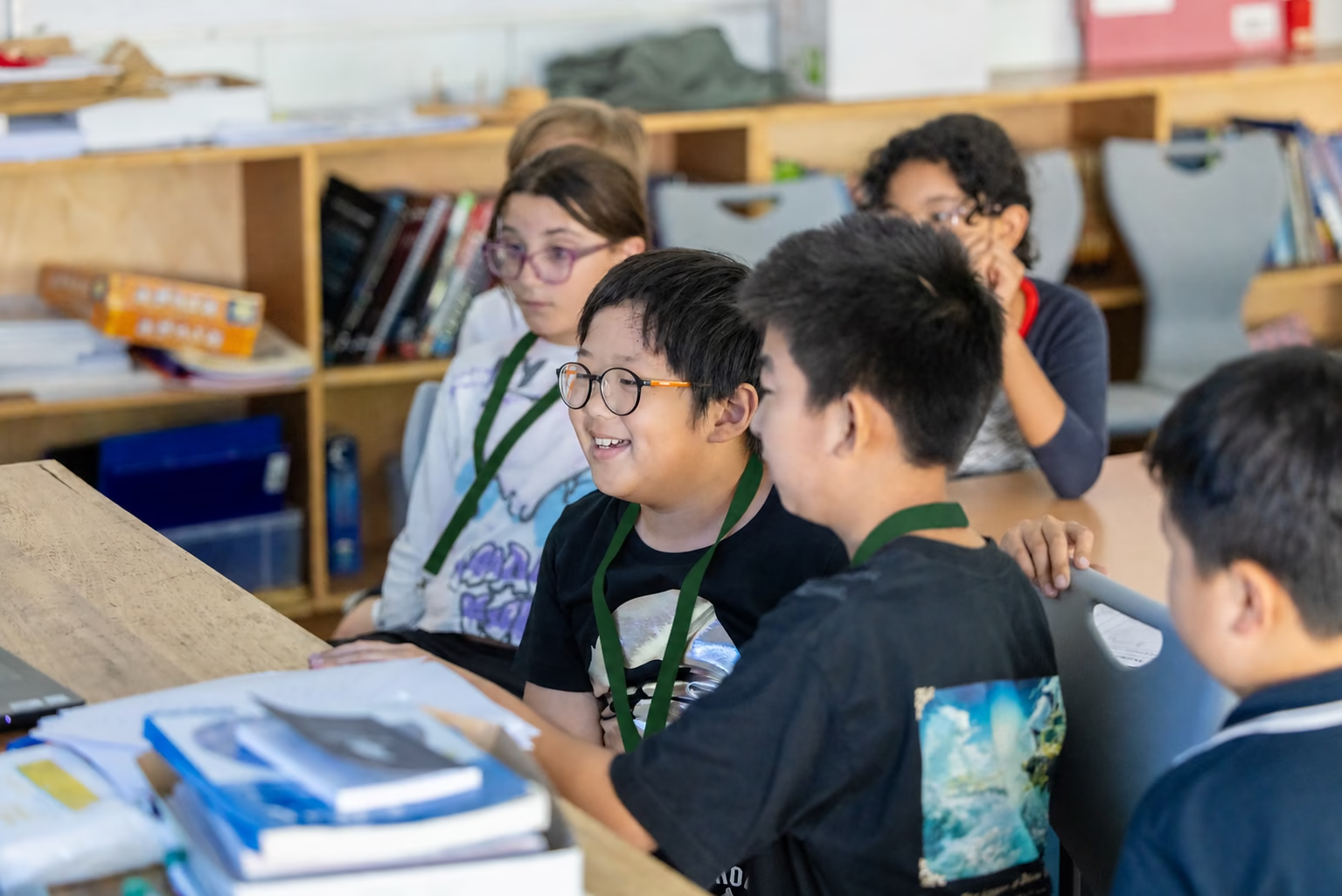
Collaborative learning is an approach where students work together to explore ideas, solve problems, discuss evidence and develop their understanding. It can happen through classroom discussions, seminars, study groups, peer teaching, practical activities or longer group projects.
But effective collaborative learning is more than simply putting students into groups. The real value comes from interaction. Students explain their reasoning, encounter different perspectives, ask questions, challenge assumptions and work towards a clearer understanding of the subject together.
Learning with others can also reveal things that independent study does not. You may discover that an idea you thought you understood is difficult to explain, hear an interpretation you had not considered or find a completely different way of approaching a problem. Used alongside independent study, collaboration can become a powerful part of learning.
What Is Collaborative Learning?
Collaborative learning describes learning activities in which two or more students actively contribute to a shared academic task or discussion. Instead of knowledge flowing in only one direction from teacher to student, learners participate in developing understanding themselves.
That might involve discussing competing interpretations of a novel, comparing solutions to a mathematics problem, debating an ethical question in medicine or working together to design and evaluate an engineering solution. The precise activity varies considerably between subjects.
What matters is that students are thinking rather than simply dividing up a workload. Strong collaborative learning requires everyone to contribute intellectually, listen to one another and engage with the reasoning behind different ideas.
Why Is Collaborative Learning Important?
One of the biggest benefits of collaborative learning is that it makes thinking visible. When you work independently, it can be easy to accept your first interpretation or solution. Other people introduce questions and perspectives that force you to examine your reasoning more carefully.
Explaining an idea also tests your own understanding. You may be able to recognise the correct answer in your notes but struggle to explain why it is correct. Having to communicate the idea clearly can expose gaps in your knowledge and show you what you need to revisit.
Collaboration also develops broader skills. Students practise communicating clearly, listening actively, managing disagreement, giving feedback and contributing to a shared goal. These skills can become increasingly important as students progress towards university and professional environments.
What Are the Benefits of Collaborative Learning?
Collaborative learning can support academic development in several different ways. Students are exposed to alternative perspectives, have opportunities to explain their reasoning and can receive immediate questions and feedback from other members of the group.
It can also make learning more active. Rather than simply listening to an explanation or rereading information, students have to retrieve knowledge, formulate arguments and respond to what other people say.
Potential benefits include:
- Developing a deeper understanding of complex ideas
- Encountering different perspectives and approaches
- Practising communication and active listening
- Identifying gaps in your own knowledge
- Developing teamwork and problem-solving skills
- Becoming more confident expressing ideas
- Learning to give and respond to constructive feedback
- Practising how to defend an argument with evidence
These benefits are not automatic. A group where one person does all the work or everyone agrees without discussion is unlikely to produce the same results. The quality of the interaction matters.
Group Discussions
Discussion is one of the simplest collaborative learning strategies. Students explore a question together, contributing arguments, evidence, interpretations and questions.
Good academic discussion is different from everyone taking turns to state an opinion. Try to respond directly to what other people have said. Ask why they reached a conclusion, introduce evidence that supports or challenges it and explain where your own interpretation differs.
You should also be willing to change your mind. If someone presents a stronger argument or points out something you had overlooked, revising your position is a sign that the discussion is working.
Peer Teaching
Peer teaching involves explaining a concept, method or topic to another student. It can be particularly useful because explaining something requires a different level of understanding from simply recognising it in your notes.
Choose a topic and try explaining it without referring to your textbook. The other person can interrupt with questions whenever something is unclear. Afterwards, check your explanation against your notes or another reliable source.
You can then swap roles. This turns revision into an active process for both students and helps prevent study groups from becoming sessions where everyone simply rereads their own material in the same room.
Collaborative Problem-Solving
Problem-solving can become more revealing when several people approach the same question independently before comparing their methods.
Rather than immediately allowing the most confident person to take control, give everyone time to consider the problem. Then compare approaches. One student may have found a faster method, another may have noticed an assumption and someone else may have identified why a particular solution will not work.
This can be particularly valuable in subjects such as mathematics, physics, engineering, computer science and economics, where there may be several ways to approach a problem.
The objective is not simply to reach the correct answer. Understanding why different approaches succeed or fail can be just as valuable.
Brainstorming and Developing Ideas
Brainstorming can help groups explore a question before deciding which direction to pursue. The initial aim is to generate possibilities rather than immediately judge every suggestion.
Once the group has a range of ideas, the more analytical stage begins. Which ideas actually address the problem? Which are realistic? What assumptions are being made? What evidence would be needed to support them?
This distinction is important. Generating ideas and evaluating them require different types of thinking, and trying to do both simultaneously can limit creativity.
Brainstorming can be particularly useful at the beginning of essays, research projects, presentations, design challenges and other tasks where there is more than one possible approach.
How to Run an Effective Study Group
A successful study group needs a purpose. Simply arranging to “revise together” can easily result in an hour of conversation without much actual learning.
Before meeting, agree on what you want to cover. You might decide to complete practice questions, test one another on particular topics or take turns explaining difficult concepts. Having a specific objective gives the session structure.
Keep everyone involved too. If one person already understands a topic well, they can explain their reasoning, but the rest of the group should still ask questions and test whether they can reproduce that understanding independently.
At the end, identify what each person still needs to work on. A study group can expose weaknesses, but individual revision is often needed afterwards to address them.
How to Divide Group Work Fairly
Group projects require collaboration, but dividing the project into four sections and disappearing until the deadline is not necessarily collaborative learning.
Begin by understanding the task together. Agree on the overall argument, objective or outcome before allocating individual responsibilities. This reduces the risk of producing separate pieces of work that do not fit together.
Responsibilities can then be assigned according to the needs of the project. Fair does not always mean identical: one person may research while another analyses data or develops part of a presentation. What matters is that responsibilities are clear and everyone makes a meaningful contribution.
Build in opportunities to review the work together before the deadline. This allows the group to identify inconsistencies, strengthen weaker sections and make sure the final result represents a genuinely shared outcome.
Active Listening in Collaborative Learning
Being good at collaborative learning does not mean being the person who speaks most frequently.
Active listening means concentrating on what another person is actually arguing and trying to understand their reasoning before preparing your response. This is particularly important when you disagree.
Ask clarifying questions. You might say, “What evidence led you to that conclusion?” or “How would that argument apply in this situation?” Questions can move a discussion forward without turning disagreement into confrontation.
You can also summarise another person's position before responding. If you can explain their argument accurately, you are much better placed to analyse or challenge it.
How to Give Constructive Peer Feedback
Feedback is most useful when it is specific enough for someone to act on.
Telling a student that their essay is “good” may be encouraging, but it gives them very little information. Instead, identify what works: perhaps the argument is clear, the evidence is well chosen or the introduction establishes the question effectively.
Do the same when suggesting improvements. Rather than saying that something “doesn't make sense”, identify exactly where the reasoning becomes unclear and explain what additional evidence, explanation or structure might strengthen it.
Receiving feedback is another important skill. You do not have to accept every suggestion, but try to understand why it was made before deciding whether to change your work.
How to Deal with Disagreement in Group Learning
Disagreement is not necessarily a problem. In academic learning, it can be extremely useful.
If two students interpret a text differently or propose different solutions to a problem, the disagreement creates an opportunity to examine the evidence. Instead of trying to establish who is “right” immediately, ask what assumptions each argument depends on and what evidence supports it.
Keep criticism focused on ideas rather than individuals. “I don't think that conclusion follows from the evidence because…” creates a productive discussion. Personal criticism does not.
Learning to disagree constructively is valuable because many interesting academic questions do not have a single straightforward answer.
What to Do When Group Work Isn't Working
Collaborative learning can become frustrating when participation is uneven, communication breaks down or members of the group have different expectations.
Address problems early. If someone has not completed an agreed task, clarify what still needs to happen and whether there is a genuine reason they are struggling. If responsibilities were unclear, redefine them.
Sometimes one student dominates the discussion while quieter students struggle to contribute. Giving everyone time to think independently before discussing an idea can help create more balanced participation.
If a serious problem cannot be resolved within the group, speak to the teacher or person supervising the project. Effective collaboration does not mean that students have to manage every difficulty without support.
Collaborative Learning vs Cooperative Learning
The terms collaborative learning and cooperative learning are sometimes used interchangeably, but they can describe slightly different approaches.
Cooperative learning often involves a task being divided into defined roles or responsibilities. Each student completes a particular part, and those contributions are combined to achieve the group's objective.
Collaborative learning tends to place greater emphasis on developing understanding together. Students may still have different responsibilities, but discussion, questioning and shared decision-making are central to the process.
In practice, many classroom activities contain elements of both. A group project might involve cooperative task allocation alongside collaborative discussion about the overall argument or solution.
Collaborative Learning vs Independent Study
Collaborative learning should not replace independent study. The two approaches develop different aspects of learning and can work particularly well together.
Working with others gives you access to alternative perspectives and immediate questions. Independent study allows you to determine what you can remember, explain and apply without support.
A useful pattern is to move between them. You might first attempt a problem independently, compare approaches with a group, discuss where your reasoning differed and then try a similar problem alone.
The final independent stage matters. Understanding something while another student is explaining it does not necessarily mean you will be able to reproduce that understanding later.
Examples of Collaborative Learning in Different Subjects
Collaborative learning does not look the same in every academic discipline.
In mathematics, students might independently solve a problem before comparing methods and discussing which is most efficient. In physics, they could make predictions about an experiment and then analyse why the results did or did not match those predictions.
In history, students might examine different primary sources and debate how reliable they are. In English literature, they could compare interpretations of a character, theme or passage and use textual evidence to defend their positions.
In medicine or biology, groups might work through a case study and consider competing explanations. In business, students could evaluate a company's strategy or develop solutions to a hypothetical commercial problem.
The strongest collaborative activities are usually those where students have something meaningful to discuss rather than simply reproducing information they could have read independently.
How Collaborative Learning Develops Critical Thinking
Collaboration can be particularly useful for developing critical thinking because other people do not necessarily share your assumptions.
When another student challenges your conclusion, you have to explain how you reached it. That may reveal that your argument is well supported, but it may also show that you have relied on an assumption or overlooked contradictory evidence.
Over time, students can become more comfortable asking questions such as: What evidence supports this? Is there another explanation? What are the weaknesses in this argument? What information would change my conclusion?
These habits extend beyond group work. Once students become accustomed to having their ideas questioned, they can begin applying the same scrutiny to their own thinking.
How Collaborative Learning Builds Communication Skills
Knowing something and explaining it clearly are different skills.
Collaborative learning repeatedly asks students to translate their thoughts into language that another person can understand. They may need to define an unfamiliar concept, explain the stages of a calculation or summarise a complicated argument.
Students also learn to adapt how they communicate. An explanation that makes sense to one person may confuse another, requiring them to approach the idea differently.
These experiences can help students become more confident contributors to seminars, presentations, interviews and other situations where they need to communicate ideas clearly.
How Collaborative Learning Can Prepare You for University
University learning frequently involves more independence than school, but that does not mean students work entirely alone.
Depending on the subject and institution, students may encounter seminars, tutorials, laboratory work, group projects, presentations and discussions alongside lectures and independent study.
Being comfortable contributing to academic conversations can therefore be useful preparation. Students need to express an opinion, respond to questions and engage seriously with perspectives that differ from their own.
Collaborative learning can also help students become less concerned with immediately having the “correct” answer. At higher levels of study, exploring a question intelligently can be just as important as reaching a conclusion quickly.
Online Collaborative Learning
Collaboration can also take place online through video calls, shared documents, discussion platforms and digital whiteboards.
The challenge is preventing technology from making communication unnecessarily complicated. Agree in advance where documents will be stored, how responsibilities will be recorded and which platform will be used for important discussions.
Shared documents can be particularly useful for group projects because students can comment on one another's work and see how the project develops. However, clear ownership of tasks is still important.
Constant communication is not the same as effective collaboration. A group chat producing notifications all day may be less productive than a scheduled 30-minute discussion with a clear objective.
How Teachers Support Collaborative Learning
Teachers play an important role in creating the conditions for productive collaboration.
Rather than simply providing the answer whenever students encounter difficulty, a teacher can ask questions that encourage the group to examine its reasoning. They may introduce an alternative perspective, ask students to justify a claim or direct attention towards something the group has overlooked.
Teachers can also structure activities so that everyone has a reason to participate. This might involve assigning different questions, asking students to prepare ideas independently before discussion or rotating responsibilities during a project.
The aim is not to remove difficulty from the learning process. Appropriate guidance helps students work through that difficulty while becoming increasingly capable of directing their own thinking.
Common Mistakes in Collaborative Learning
One common mistake is allowing the most confident student to do most of the thinking. The group may finish the task quickly, but the other students have gained relatively little from the experience.
Another is dividing every task immediately. Efficiency can be useful, but if students never discuss the overall problem, they lose much of the educational value of collaboration.
Groups can also fall into the trap of agreeing too quickly. A productive academic discussion should allow ideas to be questioned rather than treating disagreement as something to avoid.
Finally, collaboration can become a substitute for individual understanding. Always check afterwards whether you can explain the idea or complete a similar task independently.
Balancing Collaboration with Independent Thinking
Good collaborative learners do not simply adopt whatever the group decides.
Listen carefully to other perspectives, but evaluate them. Ask whether the evidence supports the conclusion and whether there might be another explanation. You should be prepared to change your mind, but you should also be able to explain why.
Independent preparation can make collaboration much stronger. If everyone arrives at a discussion having already thought about the question, the group has several developed perspectives to compare rather than relying on the first idea suggested.
Collaboration should expand your thinking rather than replace it.
Collaborative Learning at Atlas Summer Courses
At Atlas Summer Courses, small-group, discussion-based learning gives students opportunities to engage directly with academic ideas, tutors and other students.
Rather than learning only by listening, students are encouraged to ask questions, explain their reasoning and respond to different perspectives. Learning alongside students from different backgrounds can also expose participants to viewpoints and approaches they may not encounter in their usual school environment.
The precise academic format depends on the subject, course and age group. Students may encounter seminars, discussions, collaborative problem-solving, projects, presentations and independent preparation as part of their wider academic experience.
The purpose of collaboration is not simply to make learning more social. It gives students opportunities to articulate their ideas, listen carefully, respond to questions and become more confident participating in academic discussion.
Atlas Summer Courses offers independent summer programmes in Oxford and Cambridge, alongside programmes in other locations for particular age groups. Programmes run by Atlas Summer Courses are independent and are not provided by, affiliated with or part of the University of Oxford or the University of Cambridge.
Final Thoughts
Collaborative learning can make studying more active, challenging and engaging. Working with other students exposes you to perspectives you may not have considered and requires you to communicate your own thinking more clearly.
The most effective collaborative learning involves more than simply working in a group. Ask questions, explain your reasoning, listen actively, challenge ideas respectfully and use evidence when you disagree.
At the same time, keep developing your ability to work independently. The aim is not to become dependent on other people for answers, but to use discussion and collaboration to strengthen your own understanding.
When collaboration and independent study work together, you can become better at both understanding ideas yourself and exploring them with others.
About the author
Rhys Mackenzie is responsible for creating and maintaining educational content at Atlas Summer Courses, helping students and families access clear, accurate information about studying in Oxford. With several years of experience in digital content and student-focused resources, Rhys specialises in presenting academic programmes in a way that reflects the quality and integrity of Atlas Summer Courses' academic offering. Learn more about Rhys here.
Summary
Collaborative learning helps students share knowledge, improve understanding, and develop teamwork skills. Atlas Summer Courses supports collaboration through interactive discussions, group projects, and personalised feedback to enhance learning and academic success.