
A Good Tutor is the Ultimate Critical Friend

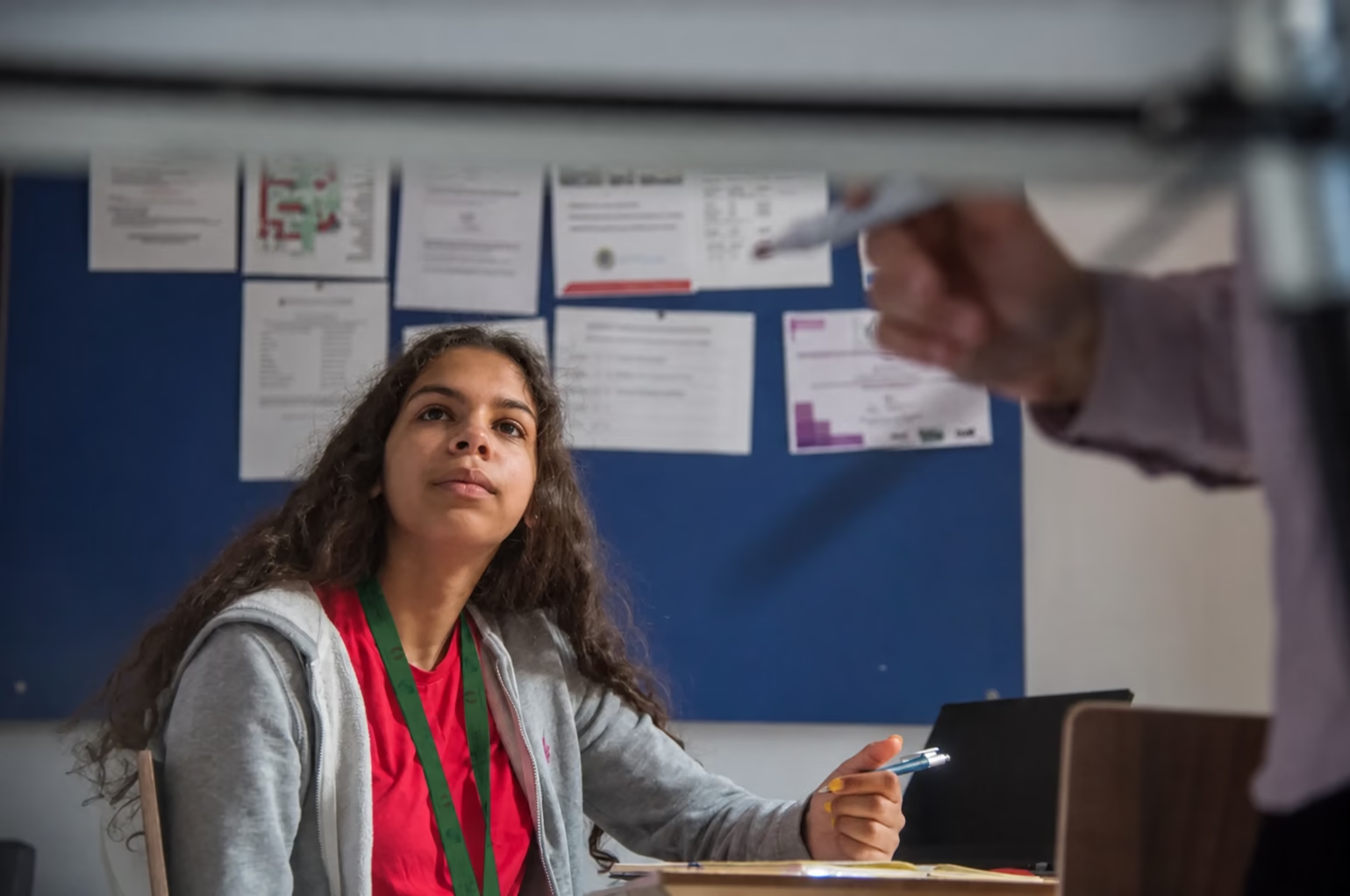
Why Good Feedback Is at the Heart of Tutorial-Style Teaching
Good feedback should help you improve.
It should show you where your argument could be stronger, where your reasoning has gone wrong and what you can do differently next time. It should also help you recognise what you are already doing well.
That is one of the reasons personalised feedback plays such an important role in teaching at Atlas Summer Courses.
For students aged 16–17 and 18–24, our academic programmes combine small-group seminars with tutorial-style teaching and independent work. Students prepare academic work before meeting with their tutor for a focused one-hour tutorial in pairs.
The aim is not for the tutor to simply tell students the correct answer. Instead, tutorials use discussion, questioning and feedback to help students examine their own ideas more carefully.
It can be challenging, but that is part of the point.
What Is Tutorial-Style Teaching?
Tutorial-style teaching is a highly interactive way of learning.
Instead of sitting in a large lecture and listening to somebody speak, students discuss their own work directly with a tutor.
Before the tutorial, students complete independent academic work connected to their subject. Depending on the course, this may involve an essay, research task or problem-based assignment.
During the tutorial, the tutor looks closely at that work and asks questions about the student's reasoning.
Why did you reach that conclusion?
What evidence supports your argument?
Is there another interpretation?
What happens if one of your assumptions is wrong?
Could you solve the problem another way?
The student is expected to think, respond and sometimes reconsider what they originally wrote.
How Do Tutorials Work at Atlas Summer Courses?
For students aged 16 and above, tutorials form part of the academic programme.
Students complete independent work before their tutorial and then meet with their tutor for a one-hour session with two students and one tutor.
Working in such a small group means there is plenty of opportunity to discuss each student's work in detail.
The tutor can examine an argument closely, question a particular decision or help a student identify exactly where their reasoning needs further development.
The second student also contributes to the discussion, meaning students can hear another perspective and learn from each other's ideas as well as from the tutor.
Why Do Students Prepare Work Before Tutorials?
The preparation gives the tutorial something substantial to focus on.
If a student has already researched a question, written an argument or attempted a difficult problem, the tutor can see how they actually think when working independently.
Perhaps the student has reached the correct answer but used an inefficient method.
Perhaps an essay contains an interesting argument but lacks evidence.
Perhaps the student has misunderstood an important concept.
These are much easier to identify when the tutor can look at the student's own work.
The tutorial then becomes a conversation about how that work can improve.
Why Doesn't the Tutor Just Give You the Answer?
Because being told the answer is not the same as understanding it.
Imagine a student has made a mistake in a problem.
The quickest response would be:
“That's wrong. Do it this way.”
The student may now know how to complete that question, but they may still not understand why their first approach failed.
A tutor can instead ask:
“Talk me through what you did here.”
Then:
“Why did you choose that method?”
And perhaps:
“What happens if we change this assumption?”
Now the student has to examine their own thinking.
When they eventually identify the problem themselves, they are more likely to understand how to approach a similar problem in the future.
The Tutor’s Role Is to Make You Think
Good tutoring is not about showing students how clever the tutor is.
It is about helping students think more clearly for themselves.
That requires restraint.
When a tutor already knows the answer, it can be tempting to interrupt immediately and explain everything.
Sometimes it is more useful to wait.
A student may correct themselves.
They may notice the contradiction.
They may realise that the evidence does not actually support the argument they have made.
That moment of discovery can be much more valuable than simply being corrected.
Why Questions Matter
A good tutorial contains plenty of questions.
Suppose a student writes:
“This policy failed because it was too expensive.”
A tutor might ask:
“Too expensive for whom?”
That immediately forces the student to become more precise.
Then:
“What evidence shows that cost caused the policy to fail?”
Now the student needs evidence rather than assumption.
Then:
“Could there have been another reason?”
One apparently simple sentence has become the starting point for much deeper analysis.
This is how questioning helps students move beyond surface-level answers.
What Makes Good Academic Feedback?
Useful feedback is specific.
Saying:
“Good essay.”
may be encouraging, but it does not tell the student what they did well.
Likewise:
“This needs work.”
does not tell them how to improve it.
Better feedback might be:
“Your main argument is clear, but this paragraph needs stronger evidence.”
Or:
“You reached the correct answer, but this step depends on an assumption you haven't explained.”
Or:
“This comparison is particularly effective because you've identified the key difference between the two theories.”
Now the student knows what worked and what needs changing.
Good Feedback Should Give You a Next Step
The most useful feedback helps a student understand what to do next.
That might mean:
- finding stronger evidence;
- explaining an assumption;
- reorganising an argument;
- considering another interpretation;
- showing more of their working;
- checking a calculation;
- developing a counterargument; or
- making a conclusion more precise.
A student should leave a tutorial with a clearer understanding of how they can improve.
That is much more useful than simply leaving with a mark.
Why Tutors Need to Challenge Students
Supportive teaching does not mean agreeing with everything a student says.
If an argument is weak, the tutor should say so.
If evidence does not support the conclusion, that should be challenged.
If a student has overlooked something important, the tutor should point it out.
The important thing is that challenge remains constructive.
The tutor is not trying to win an argument.
They are helping the student make their argument stronger.
A student should feel that their ideas are being taken seriously enough to be questioned.
Feedback Should Focus on the Work
There is an important difference between criticising a student and criticising their work.
Poor feedback might say:
“You're not very analytical.”
Useful feedback would say:
“Your conclusion doesn't follow from the evidence you've used here. Let's look at the missing step.”
The first statement labels the student.
The second identifies a problem they can actually solve.
This matters because students need to become comfortable making mistakes without interpreting every mistake as evidence that they are bad at the subject.
Why Making Mistakes Matters
Tutorials are not designed for students who already know everything.
Mistakes give tutors something useful to work with.
A student may discover that:
their argument contains a contradiction;
their evidence is weaker than they thought;
they have skipped an important step;
or they have misunderstood a concept.
Finding that out during a tutorial is valuable.
The student can investigate why they made the mistake and learn how to avoid it next time.
Feedback in Arts and Humanities Subjects
In subjects such as History, Law, Literature, Philosophy or Politics, tutors may focus on areas including:
argument;
evidence;
interpretation;
structure;
clarity;
counterarguments;
and the use of sources.
A student might be asked to defend an interpretation of a text.
A Law student may need to explain why one argument is stronger than another.
A historian may be challenged on how they have used a source.
The tutor is not necessarily trying to make the student adopt one particular opinion.
They are asking whether the student can justify the opinion they already hold.
Feedback in Science and Quantitative Subjects
Tutorials in scientific and quantitative subjects can work differently, but the principle is similar.
Getting the correct answer is not always enough.
A tutor may ask:
Why did you use this method?
What principle does it rely on?
Could you solve the problem another way?
What would change if one variable were different?
Does the result make sense?
These questions help tutors establish whether a student understands the reasoning behind a method rather than simply remembering a procedure.
Learning to Defend Your Ideas
One of the most useful things a tutor can ask is:
“Why?”
Students often write statements that feel obvious while they are working alone.
In a tutorial, they have to explain them.
Why should somebody accept this argument?
Where is the evidence?
Why is this interpretation stronger than another?
That process helps students learn to communicate their ideas more clearly.
It can also expose gaps that were difficult to see when writing independently.
Learning to Change Your Mind
A tutorial is not a debate that somebody needs to win.
Sometimes the best response a student can make is:
“I hadn't thought about that.”
Or:
“Actually, my evidence doesn't support that conclusion.”
Changing your mind after encountering better evidence is part of good academic thinking.
Students should not feel that they have failed because a tutor challenged their original argument successfully.
The ability to reconsider a position is a strength.
Why Small Tutorials Matter
With two students and one tutor, everyone needs to participate.
It is very different from sitting anonymously in a large lecture.
Students have time to explain their ideas.
The tutor can ask follow-up questions.
The second student can contribute another perspective.
And the discussion can respond directly to the work the students have prepared.
This creates a focused academic environment where students' own thinking becomes the centre of the session.
Learning From Another Student
The second student in a tutorial is not simply waiting for their turn.
They can contribute to the discussion too.
They may have approached the same problem differently.
They may disagree with an interpretation.
They may notice something the other student missed.
Hearing another student work through a question can also make your own thinking clearer.
Sometimes somebody else's mistake helps you recognise one in your own work.
Sometimes their solution introduces an approach you had never considered.
Why Tutorials Can Feel Demanding
Tutorials require concentration because students cannot remain passive.
They need to explain themselves.
Respond to questions.
Think through unfamiliar problems.
And sometimes defend an idea when the tutor is deliberately testing it.
That can feel intense.
But the aim is not to put students under unnecessary pressure.
The intensity comes from giving their ideas sustained attention.
For an hour, the conversation is focused closely on what the students have produced and how they can develop it.
What Does Personalised Teaching Mean?
Personalised teaching does not mean every student follows a completely different course.
It means tutors can respond to the students and work in front of them.
One student may have excellent ideas but struggle to structure them.
Another may write clearly but avoid taking a position.
One science student may understand the theory but make careless mistakes.
Another may produce the right answer without understanding why the method works.
A tutorial allows the tutor to focus on those individual differences.
Why Praise Should Be Specific Too
Constructive feedback does not only identify weaknesses.
Students also need to understand what they are doing well.
Instead of simply saying:
“Great work.”
a tutor might say:
“Your introduction works particularly well because you establish your argument immediately.”
Now the student knows what to repeat in future work.
Specific praise is more useful because it helps students recognise their strengths rather than simply making them feel good for a moment.
Can Tough Feedback Build Confidence?
It can, when it is delivered properly.
Academic confidence should not depend on believing everything you produce is excellent.
A stronger form of confidence is knowing that you can produce something imperfect, receive criticism and improve it.
The process becomes:
Attempt.
Feedback.
Revision.
Improvement.
Once students become comfortable with that cycle, difficult work can feel less intimidating.
A first attempt does not need to be perfect because there will be opportunities to develop it.
The Relationship Between Care and Challenge
There is an interesting parallel between academic feedback and the way feedback is sometimes discussed in professional environments.
Kim Scott's concept of Radical Candor, for example, argues that effective feedback combines caring about the person with being willing to challenge them directly.
The contexts are obviously different, but the principle translates well to education.
A good tutor should care about a student's progress enough to tell them when something is not working.
Avoiding difficult feedback may feel kinder in the moment.
It is not necessarily more helpful.
The Socratic Approach to Learning
The idea of teaching through questioning is far from new.
Socratic teaching is associated with helping learners examine their assumptions through questions rather than simply giving them conclusions.
The tutor guides the conversation but expects the student to do much of the intellectual work.
That principle fits naturally with tutorial-style learning.
The tutor has subject expertise.
But the student's job is still to think.
Critical Thinking Through Tutorials
Critical thinking involves learning to examine information carefully.
Students may ask:
What is the evidence?
How reliable is it?
What assumptions are being made?
Does the conclusion actually follow?
Is there another explanation?
What would make me change my mind?
These questions can be applied across almost every academic subject.
Tutorials give students an opportunity to practise asking them repeatedly.
Becoming a More Independent Learner
The long-term aim is for students to begin asking these questions without the tutor being there.
At first, a tutor may have to say:
“Where is your evidence?”
Eventually, the student begins asking themselves that while writing.
The tutor may initially ask:
“Does that conclusion really follow?”
Later, the student begins checking their own reasoning before submitting the work.
This is one of the most important developments in independent learning.
Students gradually become better at evaluating their own work.
Preparing for a Tutorial
Good tutorials depend on good preparation.
Students should complete the assigned work before arriving.
They should also look at it again and identify the areas they are least confident about.
Useful questions to ask beforehand include:
Which part did I find most difficult?
Where am I least confident in my argument?
What assumption am I making?
Is there anything I could not solve?
What would I most like my tutor to explain?
Students do not need to hide the parts they struggled with.
Those may produce the most useful discussions.
During the Tutorial
Participate actively.
Explain your reasoning.
Ask questions.
Listen to the other student.
If you disagree with your tutor, explain why.
If you realise your original argument does not work, say so.
The objective is not to protect every sentence you wrote.
It is to improve your understanding.
Tutorials become far more useful when students approach feedback with curiosity rather than defensiveness.
After the Tutorial
The learning should not stop when the hour ends.
Students can look back at the feedback and ask whether the same issues appear elsewhere in their work.
Perhaps the tutor identified weak evidence in one paragraph.
Does the same problem appear in another?
Perhaps a particular calculation error occurred once.
Is it part of a pattern?
The most useful feedback is transferable.
Students begin recognising their own habits and correcting them independently.
Tutorial Work and Course Completion
For students aged 16–17 and 18–24, completing tutorial work is also an important part of successfully completing the Atlas academic programme.
Students in these age groups are required to submit both pieces of tutorial work in order to receive their Letter of Recommendation after the course.
The Letter of Recommendation contains personalised tutor feedback and is reviewed by the Atlas Academic Team before being issued.
This makes tutorial work part of both the learning experience and the student's final academic record from the programme.
Personalised Feedback After the Course
Feedback continues beyond the tutorial itself.
Students who successfully complete their programme receive a Letter of Recommendation containing personalised feedback from their tutor or tutors.
Tutors submit their reports at the end of the course, and the Atlas Academic Team reviews them before they are sent to students.
Most students receive their Letter of Recommendation within three weeks of completing their programme.
Students also receive a digital certificate confirming their attendance and course dates.
Can Tutorial-Style Learning Help Prepare Students for University?
It can introduce students to habits that become increasingly important in higher education.
These include:
independent preparation;
academic discussion;
critical analysis;
responding to feedback;
defending an argument;
and taking responsibility for improving your own work.
A summer programme is not the same as a university degree.
But students can experience a more independent way of learning and find out how they respond to it before progressing to higher education.
Is Atlas Tutorial-Style Teaching the Same as Oxford or Cambridge University Teaching?
No.
Atlas Summer Courses is an independent summer education provider.
Our programmes in Oxford and Cambridge use tutorial-style teaching as part of the Atlas academic model.
Students attending an Atlas programme are not University of Oxford or University of Cambridge students, and Atlas tutorials are not tutorials provided by either university.
Tutorial-style teaching is a method of learning. It does not imply institutional affiliation.
Why Feedback Matters at Atlas Summer Courses
The purpose of feedback is not simply to point out mistakes.
It is to help students become better at evaluating their own ideas.
A student prepares work.
They discuss it with their tutor.
Their assumptions are tested.
Their strengths are recognised.
Weaknesses are identified.
And they leave with a clearer idea of what they can do next.
Over time, students can begin doing more of that process for themselves.
That is what makes personalised feedback such an important part of independent learning.
Frequently Asked Questions About Tutorial-Style Teaching
Who Takes Part in Tutorials?
Tutorial-style teaching forms part of the academic programme for Atlas Summer Courses students aged 16–17 and 18–24.
How Many Students Are in a Tutorial?
Tutorials involve two students and one tutor.
How Long Does a Tutorial Last?
Each tutorial lasts one hour.
What Do Students Do Before Their Tutorial?
Students complete independent academic work connected with their subject. The exact assignment depends on the course.
What Happens During the Tutorial?
Students discuss their work directly with their tutor, answer questions, examine their reasoning and receive personalised feedback.
Does the Tutor Give Students the Answers?
Tutors provide academic guidance and explanations where needed, but the tutorial is designed to encourage students to think through questions rather than simply being handed every answer.
Do Students Receive Written Feedback?
Students who successfully complete their programme receive a Letter of Recommendation containing personalised feedback from their tutor or tutors.
Do Students Have to Complete Their Tutorial Work?
Students aged 16–17 and 18–24 need to submit both pieces of tutorial work to meet the completion requirements for receiving their Letter of Recommendation.
Is Atlas Summer Courses Part of Oxford University?
No.
Is Atlas Summer Courses Part of Cambridge University?
No. Atlas is independent of both universities.
Final Thoughts
Good feedback is not always the feedback that is easiest to hear.
Sometimes the most useful comment is the one that makes you reconsider an argument you were certain about.
Sometimes it is a tutor asking:
“Why?”
and refusing to move on until you can explain your answer.
Sometimes it is discovering that the solution you reached is correct but the reasoning behind it is not.
That is what tutorial-style teaching is designed to uncover.
For students aged 16+, Atlas Summer Courses combines independent academic work with one-hour tutorials involving two students and one tutor. Students discuss their work directly with their tutor, receive personalised feedback and are encouraged to examine their reasoning in greater depth.
The goal is not simply to produce a better essay or solve one particular problem.
It is to become better at thinking about your own work.
To question assumptions.
Recognise weaknesses.
Defend strong ideas.
Respond constructively to criticism.
And eventually begin giving yourself some of the same feedback that previously needed to come from a tutor.
That development towards greater academic independence is what makes tutorial-style teaching valuable.
Experience Tutorial-Style Teaching at Atlas Summer Courses
Students aged 16–17 and 18–24 can experience small-group seminars, independent academic work and personalised tutorials as part of their Atlas Summer Courses programme.
Explore our academic courses in Cambridge, learn more about our teaching methodologies, or discover the wider academic experience.
Atlas Summer Courses is an independent summer education provider and is not affiliated with the University of Oxford or the University of Cambridge.
Apply now to begin your application.
About the author
Rhys Mackenzie is responsible for creating and maintaining educational content at Atlas Summer Courses, helping students and families access clear, accurate information about studying in Oxford. With several years of experience in digital content and student-focused resources, Rhys specialises in presenting academic programmes in a way that reflects the quality and integrity of Atlas Summer Courses' academic offering. Learn more about Rhys here.
Summary
Discover the parallels between effective tutoring and delivering tough feedback. At Atlas Summer Courses, our tutorial-style teaching fosters independent learning and critical thought. Learn how Radical Candour principles align with creating a supportive learning environment.